
Robin Feldman
AI Versus IP
I would love if a “just-browsing” reader were to land on the section explaining how LLMs work. I tried to craft an analogy that has the virtue of precision while using no math so that anyone can understand it. Specifically, I use the analogy of mapping everything there is to know about Washington D.C. by creating a multi-dimensional map – not just a three-dimensional map, but a 300-dimensional map. The objective is to create a map so detailed that it captures not just landmarks like the White House, but also the vibe of neighborhoods, the flow of the Potomac, and even the buzz of government in action. Readers will see how the mapping process employs an army of tour guides who begin with useless, random numbers and end up with finely developed expertise. At the end of the section, readers should have a much clearer and more accurate picture of how an LLM works.
One of my favorite quotes lies in the section describing how society bestows value on intangible things such as intellectual property. Here is the relevant excerpt, with the favorite part in italics: “[O]ne should begin by understanding a remarkable ability within our society: We are able to bestow value on things that do not exist simply by creating a myth that everyone believes. In other words, things we cannot see or touch have value simply because we believe they do. [For example,]it is only our collective belief in the value of money that grants it the status of “the root of all evil” (as noted in the King James version of the Bible) and the driving force that “makes the world go round” (as noted in the musical and movie, Cabaret). Or, as a country western song explains, “Money can’t buy everything. Well, maybe so. But it could buy me a boat.If humans simply stopped believing money has value, the global economy would collapse. We’d find our pockets full of little more than shreds of paper and shiny disks.”
Another favorite quote is tucked into the section on shared understandings. “To communicate effectively, all societies need a certain level of commitment to – and shared understanding of – those things that we believe exist. … These shared understandings help us grasp and categorize the world around us and enable us to communicate with one another coherently. Without them, we run into problems.If, for example, John believes sidewalks are infinitely expandable, then he may have difficulty explaining to a police officer – who believes in the finite nature of space – why he tried to drive his car on the sidewalk.”
Asking an author to pick favorite quotes is a little like asking a parent to pick a favorite child. How could I possibly choose? With that in mind, I can’t resist adding another. The following excerpts are from the section exploring solutions: “Consider the ubiquitous Nutrition Facts label, which can be found on most packaged foods. From bread and milk to cereal and seaweed snacks, virtually all packaged foods display basic nutrition information in an easy-to-assimilate format.Wouldn’t it be nice if people could similarly determine the extent to which products we consume from information-related industries are made of high-quality ingredients . . . so that people know the “nutritional quality” of what they are consuming.Eventually, a small box, about the size of the Nutrition Facts label, could become instantly recognizable and universally trusted for evaluating information products.
And this final quote is a favorite because it captures issues of particular importance to me: “This is not to suggest that the certification body would provide an analysis of whether the contents represent ‘The Truth.’ Rather, the goal would be to provide information on the sources and methods, letting consumers make their own choices in the marketplace of ideas.”If the book is successful, it could help legal scholars and computer engineers find a common frame of reference. Beyond contributing to shared understandings, I hope the book prompts industry leaders and policy makers to engage in the joint enterprise of trust benchmarking. Developing trust mechanisms in this manner will strengthen the intellectual property regimes, ensure consumer confidence, and help AI develop to its full potential.More broadly, the book can highlight the way in which AI may substantially shrink the pool of things eligible for IP protection, as well as shake confidence, dissolve mystique, and undermine the value proposition of the various IP regimes themselves. This awareness could lead policy makers to adjust intellectual property regimes in the manner recommended.Moving from the broad to the narrow, the chapter on Hot Topics points the way to resolution of the numerous lawsuits regarding whether LLMs violate copyright. I hope the analysis helps inspire settlement of the issues.Finally, and most important, I hope the book fosters a sense of caution that any of us know the perfect answer to the questions AI will continue to bring. With this in mind, I close my comments with a combined excerpt from the introduction and conclusion: One can predict much wailing and gnashing of teeth as we step into this next iteration of human–technological interaction. Nevertheless, we should borrow a concept from both existential philosophers and their arch opponents, theologians, to note that the enterprise we are embarking on demands a little humility. An expert in the field of AI recently told me—we always thought that when we reached this point with AI, we would understand much more about cognition than we do now. And, indeed, the gap between the state of our technology and our understanding of it, as well as its impact, is vast. Not only have we come very far, but also, we have very far to go. In that context, one of Alexander Pope’s three-centuries-old observations remains remarkably prophetic: “Fools rush in where Angels fear to tread.” In truth, as AI continues to develop and society scrambles to adapt, we still have a lot of learning left to do—about the technology, about its impact, and most important, about how society should best approach it.
Curator: Bora Pajo
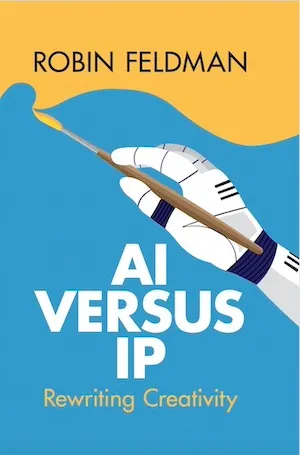
AI Versus IP
Robin Feldman AI Versus IP: Rewriting Creativity Cambridge University Press 228 pages, 6 x 9 inches, ISBN 978-1009646864
Available here →September 5, 2025
20250905-feldman-robin-on-ai-versus-ip-3
A close-up
The rest of this thread

Robin Feldman
Professor Feldman is an award-winning scholar and science writer whose work has been called "absolutely remarkable" and "a must read." Her areas of emphasis include Law and Al, Law and Medicine, and Competition.Sheis the Arthur J. Goldberg Distinguished Professor of Law at University of California Law, San Francisco, and Director of theAI Law & Innovation Institute.
Pull this thread
AI will shrink the pool of material eligible for intellectual property protection and drain value from protection itself.
Know something the rest of us don't?
Most threads on Rorotoko begin with our invitation. Any thread can begin with a proposal: you write it with the same prompts every thread answers, and we review it.
Propose a thread →