
Robin Feldman
AI Versus IP
From a broad, theoretical perspective, intellectual property is underpinned by the philosophy of utilitarianism. At the risk of wildly oversimplifying moral philosophy, utilitarianism considers the ‘utility,’ that is, the total outcome of an action, on balance. There is broad agreement among scholars that US intellectual property regimes in the modern context are largely conceptualized in utilitarian terms – that is, they are conceived as vital policy mechanisms designed to promote broader societal benefit by incentivizing innovation and creative expression.
In this utilitarian context, intellectual property regimes have largely assumed the centrality of humans to the innovation and creativity process. The rapid progress in AI challenges that human-centered assumption, forcing us to confront our conceptions of what we protect and the value of human contribution to progress.
For example, if AI systems can easily produce much of what humans invent, create, or capture through trade secrets, many human contributions to creativity may no longer satisfy the requirements of protection. Do we care whether we protect human innovation? From another perspective, if consumers use influencers or private rating systems as their indications of quality, rather than looking for the trademark, what is to become of the trademark system? As I comment in the book, with due apologies to my distinguished publisher Cambridge University Press, readers seem to be relying less and less on the hallowed publishing houses, whose reputations are protected by trademark, as a reliable indicator of what to read.
Beyond the theoretical, the book addresses current conversations about AI and IP. Thus, the book examines the pending court cases concerning whether large language models (LLMs) such as ChatGPT, Gemini, Claude, and Grok, infringe copyright by training on existing works or by reproducing near copies of existing works in response to particular prompts. The book predicts where the courts and the industry are likely to go in resolving these problems and suggests possible points of resolution.
Finally, the book bridges gaps in knowledge. Legal scholars may understand intellectual property, but most do not understand the math and science of AI systems. Computer engineers may understand AI, but most do not understand the strange beasts that make up intellectual property. How can policymakers design appropriate AI policies without some depth of knowledge of what modern AI systems do; and how can engineers design AI systems without a basic understanding of the laws we would like these systems to respect? I wanted a book that would speak to both groups and leave everyone understanding the quandaries and potential pathways ahead.
As a law professor, I direct the AI Law & Innovation Institute at UC Law San Francisco, which frequently provides technical advice to government; as a scholar, I published my first piece on AI more than 20 years ago and have written about numerous aspects of AI and society; and as a science writer, I’m committed to making complex technical topics clear to the intelligent reader. Thus, the book attempts to help others identify the connections, ideas, and issues arising from this convergence of AI and IP.
Curator: Bora Pajo
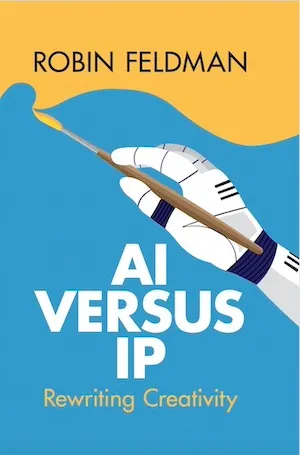
AI Versus IP
Robin Feldman AI Versus IP: Rewriting Creativity Cambridge University Press 228 pages, 6 x 9 inches, ISBN 978-1009646864
Available here →September 5, 2025
20250905-feldman-robin-on-ai-versus-ip-2
The wide angle
The rest of this thread

Robin Feldman
Professor Feldman is an award-winning scholar and science writer whose work has been called "absolutely remarkable" and "a must read." Her areas of emphasis include Law and Al, Law and Medicine, and Competition.Sheis the Arthur J. Goldberg Distinguished Professor of Law at University of California Law, San Francisco, and Director of theAI Law & Innovation Institute.
Pull this thread
AI will shrink the pool of material eligible for intellectual property protection and drain value from protection itself.
Know something the rest of us don't?
Most threads on Rorotoko begin with our invitation. Any thread can begin with a proposal: you write it with the same prompts every thread answers, and we review it.
Propose a thread →