
Juliana M. Pistorius
Postcolonial Opera
What comes to mind when you think of opera? For most people, the word summons some variation on belting ladies, black tie, red velvet seats, opulent theatres, and diamond-encrusted snobbery from an increasingly aging public. In other words, we generally associate opera with a very specific vision of elite European culture.
But opera also exists in unexpected places. It can be found in car parks and bars, among young people and incarcerated persons. It also flourishes in postcolonial spheres such as South Africa, where the art form has become an integral part of Black cultural identities.
The popularity of opera in former colonies belies the art form’s association with a European cultural elite.
Postcolonial Opera: William Kentridge and the Unbounded Work of Art asks what political and cultural work opera does in postcolonial spheres. Whose interests does the art form serve? Whose history and culture does it represent? Whose stories does it tell? And even more importantly, how does it tell these stories?
The book does two things: it examines the role of opera in the postcolony, and it engages with William Kentridge’s experimental theatre works. Kentridge is South Africa’s most famous living artist. He enjoys global renown, with blockbuster exhibitions at the most important museums and galleries in the world. Kentridge is an interdisciplinary artist with a profound interest in sound and performance.
Over the past three decades, he has created operas for institutions such as New York’s Metropolitan Opera, Covent Garden in London, and La Monnaie in Brussels. He has also produced several experimental works, which play with the operatic medium in fascinating ways. The unbounded work of art is Kentridge’s concept. He uses it to describe an approach to art-making that is capacious in a Dadaist sense. For Kentridge, anything can be part of the work of art.
The boundaries around media are flexible: drawing can also be dance; sculpture can also be performance. Kentridge contrasts this approach with the Wagnerian idea of the total work of art, which is especially about coherence and control. In its place, Kentridge embraces an art of chance, coincidence, and unpredictability.
In Postcolonial Opera, Kentridge’s performance pieces anchor a discussion of opera’s capacity to process the political and ethical demands of the postcolonial present. Each chapter relates a Kentridge case study to one concept from postcolonial critical theory.
The book starts by examining the history of opera in colonial spheres: is the art form really a colonial import? Or can we trace Indigenous performance traditions that are themselves operatic? If we think of opera as a form of storytelling through music, then there are many Indigenous performance traditions that do the same thing. Thus, I problematise the idea that opera somehow “belongs” to the West.
Having established that opera does have a place among pre-colonial, colonial, and post-colonial Indigenous societies, I use the rest of the book to explore the tensions between opera’s role as a colonial art form, and its position as a form of Indigenous expression. I ask, specifically, whether opera can participate ethically in postcolonial acts of confession; what it means for opera to perform postcolonial mourning; how opera articulates and refigures ways of being “in time” in the postcolony; how opera makes place (and enables different forms of inhabitation) for the itinerant or displaced postcolonial subject; and how opera deals with ideals and inheritances of totality in the postcolony.
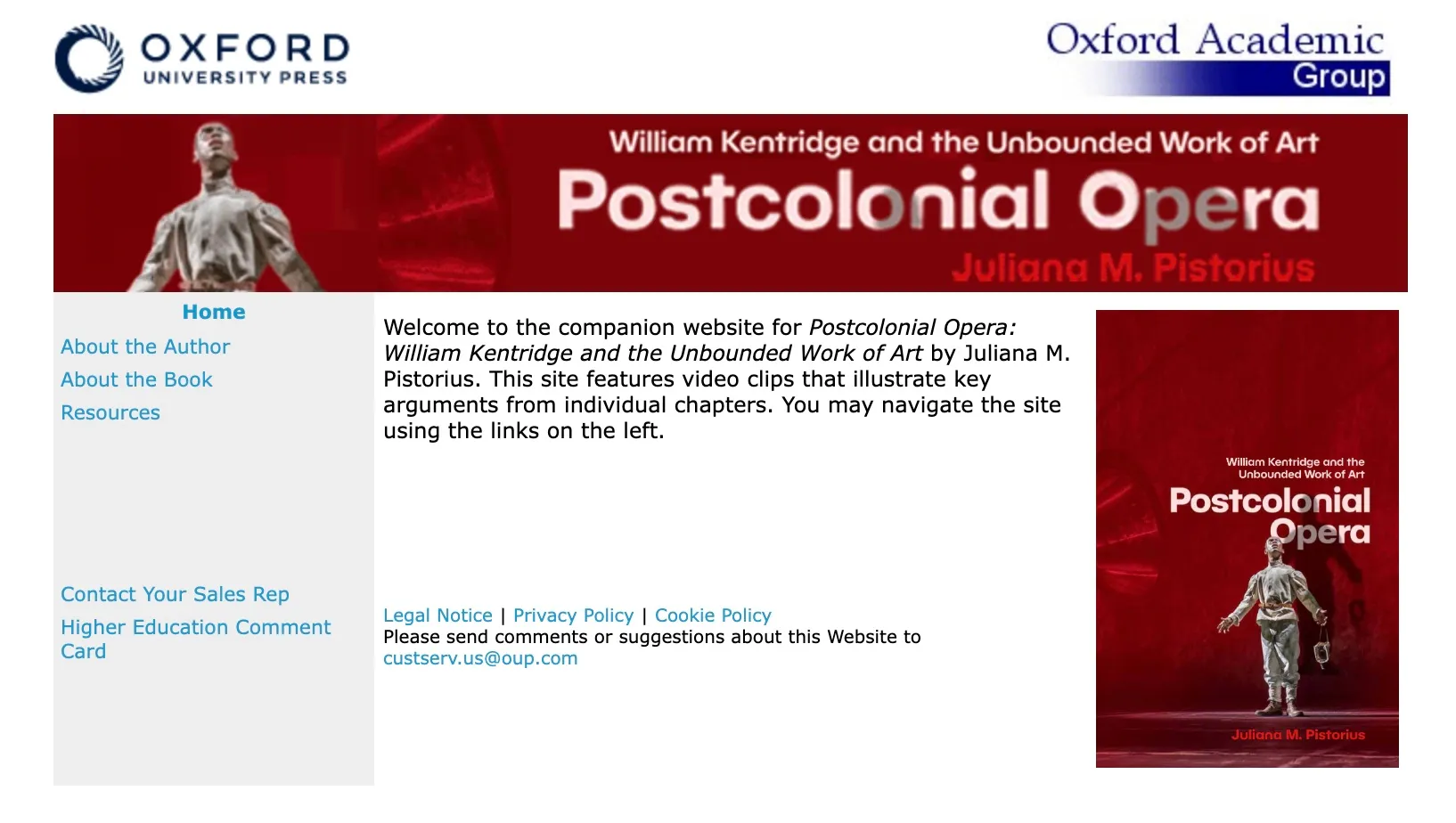
Oxford University Press created a companion website for the book, featuring short audio-visual samples tied to the text. Icons in the book signal when to view or listen online.
Curator: Bora Pajo
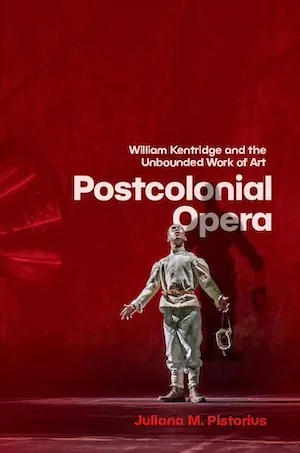
Postcolonial Opera
Juliana M. Pistorius Postcolonial Opera: William Kentridge and the Unbounded Work of Art Oxford University Press 304 pages, 6.35 x 9.17 inches ISBN 978-0197749210
Available here →September 12, 2025
20250912-pistorius-juliana-on-postcolonial-opera-1-1
In a nutshell
The rest of this thread

Juliana M. Pistorius
Juliana M. Pistorius is a Marie Skłodowska-Curie Global Research Fellow at the Institute of Advanced Studies, University College London. She has held research fellowships at the University of Huddersfield, Wits University, and Africa Open Institute of Music, Research, and Innovation. She is a founding member of the Black Opera Research Network.
Pull this thread
All opera is postcolonial, but opera cannot be decolonial.
Know something the rest of us don't?
Most threads on Rorotoko begin with our invitation. Any thread can begin with a proposal: you write it with the same prompts every thread answers, and we review it.
Propose a thread →