
Juliana M. Pistorius
Postcolonial Opera
When I tell people that I study opera in South Africa, they almost always say, “I didn’t know there’s opera there!” Fact is, there’s a very vibrant operatic culture in South Africa. This is also true for other former colonies, both on the African continent and in other parts of the world. One of the questions that interest me, is why people are surprised that opera could thrive in a place like South Africa.
I am myself a classically-trained South African pianist. While pursuing my training, I often had to ask myself what it means for me to spend hours and hours practicing my instrument, while so many people in my country struggle to find sufficient food, accommodation and safety. How do we justify the money and time we invest in classical music in a place like this? Which values attach to classical music in a place like South Africa? These questions continue to activate my intellectual project.
Postcolonial Opera starts from the premise that all opera is somehow postcolonial. I understand a practice to be postcolonial if it reflects colonial structures back to us, or if it brings these structures to light and/or comments on them. Opera contains the conditions of coloniality within itself. The art form represents modernity, which, as Walter Mignolo argues, is always already intertwined with coloniality. Mignolo calls this the “modernity/coloniality” bind. So, if opera represents modernity, it also necessarily represents coloniality. Opera reflects coloniality in other ways, too: operatic works, for instance, often assume an orientalist gaze. This is especially true for canonical works from the Euro-American repertoire. Frequently, opera functioned as a marker of colonial subjects’ civility, and of their connectedness with the European hinterland. Moreover, opera houses were built from raw materials extracted from colonies, or acquired using the wealth gained from colonial possessions. And finally, opera circulated around the world along the routes of colonial expansion.
The book is primarily aligned with two disciplines: opera studies and postcolonial theory. But it also incorporates performance studies, theories of form and genre, and scholarship on visual art. Postcolonial Opera especially forms part of a recent turn towards issues of race, coloniality, and representation in opera studies. Naomi André’s 2018 monograph, Black Opera: History, Power, Engagement, remarks on the “shadow history” of Black participation in opera, both in the USA and South Africa. Even at times when opera appeared to be reserved for white artists and audiences, André shows that Black musicians took the art form and made it theirs. My book builds on André’s pioneering work by thinking specifically about the ways in which these “shadow cultures” interact with the structures of the postcolony. Kentridge’s works are not necessarily representative of postcolonial opera in general. But they foreground many of the issues that characterise postcolonial opera writ large. For instance, Kentridge’s works are all collaboratively produced.
They also incorporate non-operatic, Indigenous performance traditions, including music, dance, mime, and masquerade. Kentridge’s operatic works welcome a multitude of traditions, from the European avant-garde to anti-colonial and anti-apartheid art forms. As a result, they are heterogeneous and transcultural productions, which represent a hybrid model unmarked by conventional distinctions between the so-called “high” and “popular” or “folk” arts. Kentridge also incorporates multilingualism, and he uses his works to tell stories that expand on and even problematise the standard Western histories we encounter on stage. These are all characteristic features of operatic cultures that exist beyond the European norm.
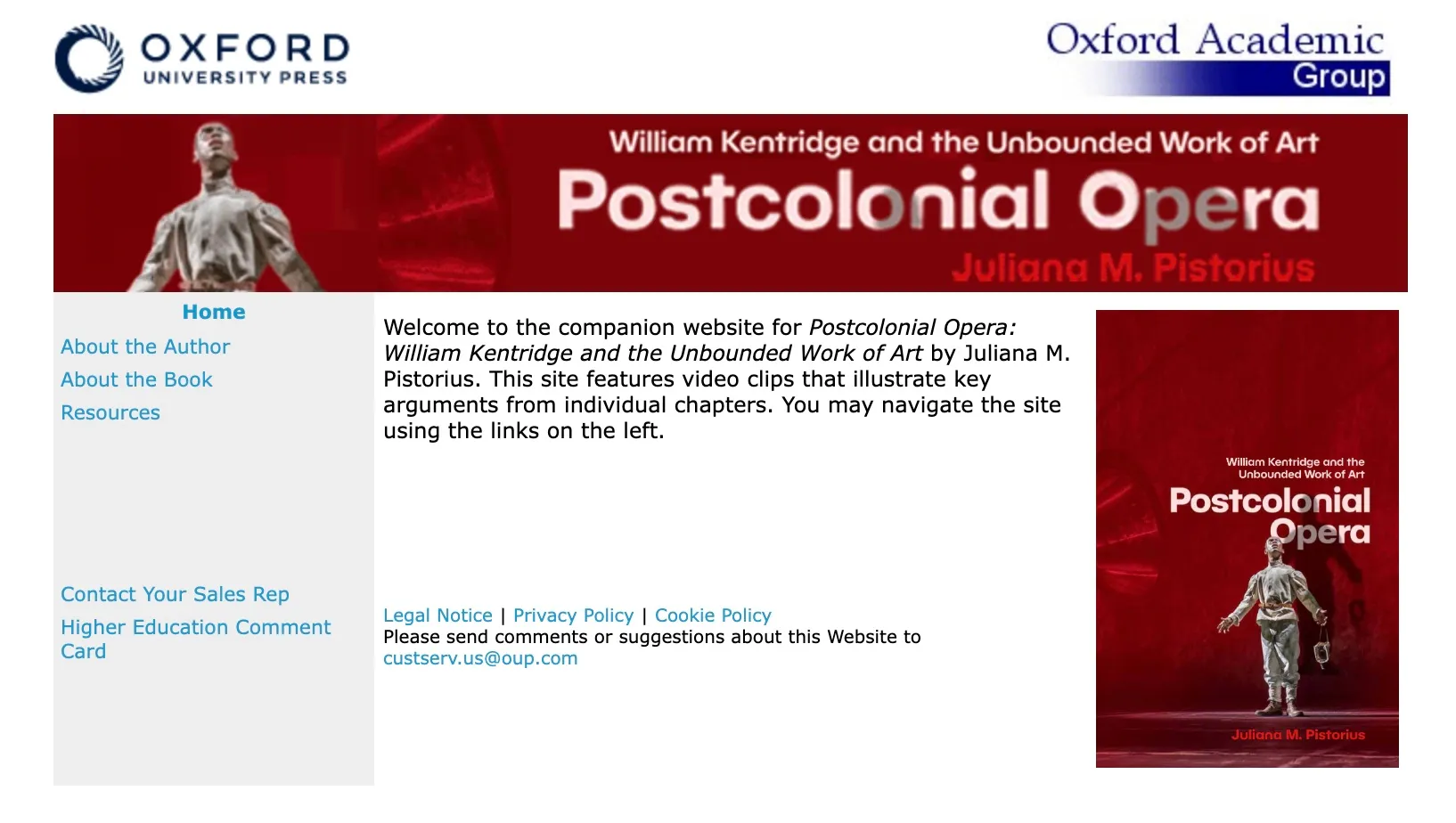
Oxford University Press created a companion website for the book, featuring short audio-visual samples tied to the text. Icons in the book signal when to view or listen online.
Curator: Bora Pajo
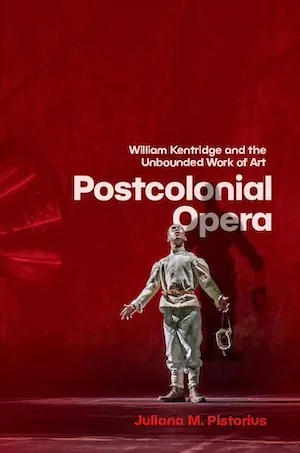
Postcolonial Opera
Juliana M. Pistorius Postcolonial Opera: William Kentridge and the Unbounded Work of Art Oxford University Press 304 pages, 6.35 x 9.17 inches ISBN 978-0197749210
Available here →September 12, 2025
20250912-pistorius-juliana-on-postcolonial-opera-2
The wide angle
The rest of this thread

Juliana M. Pistorius
Juliana M. Pistorius is a Marie Skłodowska-Curie Global Research Fellow at the Institute of Advanced Studies, University College London. She has held research fellowships at the University of Huddersfield, Wits University, and Africa Open Institute of Music, Research, and Innovation. She is a founding member of the Black Opera Research Network.
Pull this thread
All opera is postcolonial, but opera cannot be decolonial.
Know something the rest of us don't?
Most threads on Rorotoko begin with our invitation. Any thread can begin with a proposal: you write it with the same prompts every thread answers, and we review it.
Propose a thread →