
Juliana M. Pistorius
Postcolonial Opera
The most important thing I’d like a casual reader or browser to engage with is the book’s companion website. Writing about music, theatre, and dance often feels restrictive—one can only capture so much in words. In response to the restrictions posed by print, Oxford University Press has created a website to accompany the book. Here, the press hosts a number of short audio-visual samples of material discussed in the book. The relevant videos are indicated with a little icon in the text, so the reader knows when to look at or listen to an item online. It’s a brilliant way to incorporate multimedia into print.
Even without reading the book, the casual browser can turn to these video examples for an introduction to Kentridge’s audio-visual world. Kentridge’s theatre pieces are beautiful, humorous, moving, intriguing, and challenging. They open new perspectives on colonial history and performance, even for audiences unfamiliar with the historical or aesthetic intertexts referenced in the artist’s work. Kentridge’s art has a unique capacity to make people reflect on their own relationship to histories of colonialism and racial exploitation. Apart from the companion website, there are of course other bits of the book with which I am particularly pleased. I love the quotes from Kentridge’s pieces. These bits of text, which are peppered throughout the book, reflect the artist’s sense of humour, and his capacity to integrate divergent frames of reference into a single, often absurd, framework.
Thinking of a specific section of the book, I continue to marvel at the near-simultaneity of the International Prime Meridian Conference (which decided on Greenwich as the zero point for global clock time) and the Berlin Conference (which partitioned Africa among the different colonial powers) in 1884. These conferences, which together had profound consequences for the African continent and its colonial rulers, form the starting point for Chapter 4, ‘Time’. I hope that casual readers looking through the book might pick up one or two strands from this chapter, to realise how coincidental our current temporal regime is. Clock time is not a given, nor does non-adherence to it necessarily signal failure.I close the book with a reflection on operatic postcoloniality and decoloniality.
Over the past decade, the academy has increasingly begun to prioritise decolonial epistemologies and methodologies. The same is true for musicology, which is traditionally a profoundly Eurocentric discipline. Given opera’s complicity in various forms of coloniality, it is perhaps natural that opera studies has also increasingly begun to look for ways in which the art form may serve the decolonial agenda.
When I started this project, I intended to study a number of South African operas to see how they represented the aims and priorities of decolonisation. However, in the process of doing this work, I realised that opera as a genre is too deeply embedded in the structures and networks of modernity and late capitalism to participate truthfully or unproblematically in a decolonial project.
Even so-called Indigenous operas continue to be heard through the sonic structures of European opera. If decolonisation represents, in Mignolo’s terms, a delinking from modernity, then opera as an institution would have to become something else before it can truly decolonise. Consequently, I conclude that opera has tremendous capacity for postcolonial representation and critique, but that its role as an agent of decolonisation is more limited.
That being said, I do think that certain forms of operatic experimentation have the potential to realise decolonial approaches and methodologies: I think especially of works created through non-hierarchical, collaborative processes; works that destabilise the distinction between audience and performers; works that do not aspire to repetition or circulation; and works that embrace notions of performance-as-knowledge-making, as memory, as history, and as community, rather than as discipline.
There are vast numbers of interesting operas and creators coming out of formerly colonised spheres. I would like Kentridge’s creations, and their treatment in this book, to serve as a first step towards thinking about the incredible variety of theatrical work from postcolonial societies, and about how these works interact with what we understand opera to be. Ultimately, the aim of Postcolonial Opera is to think anew about the borders we draw around genres. The book invites us to reflect on the assumptions we make about different forms of art, about where they belong and to whom, and about the ways in which we lay claim to cultural identities.
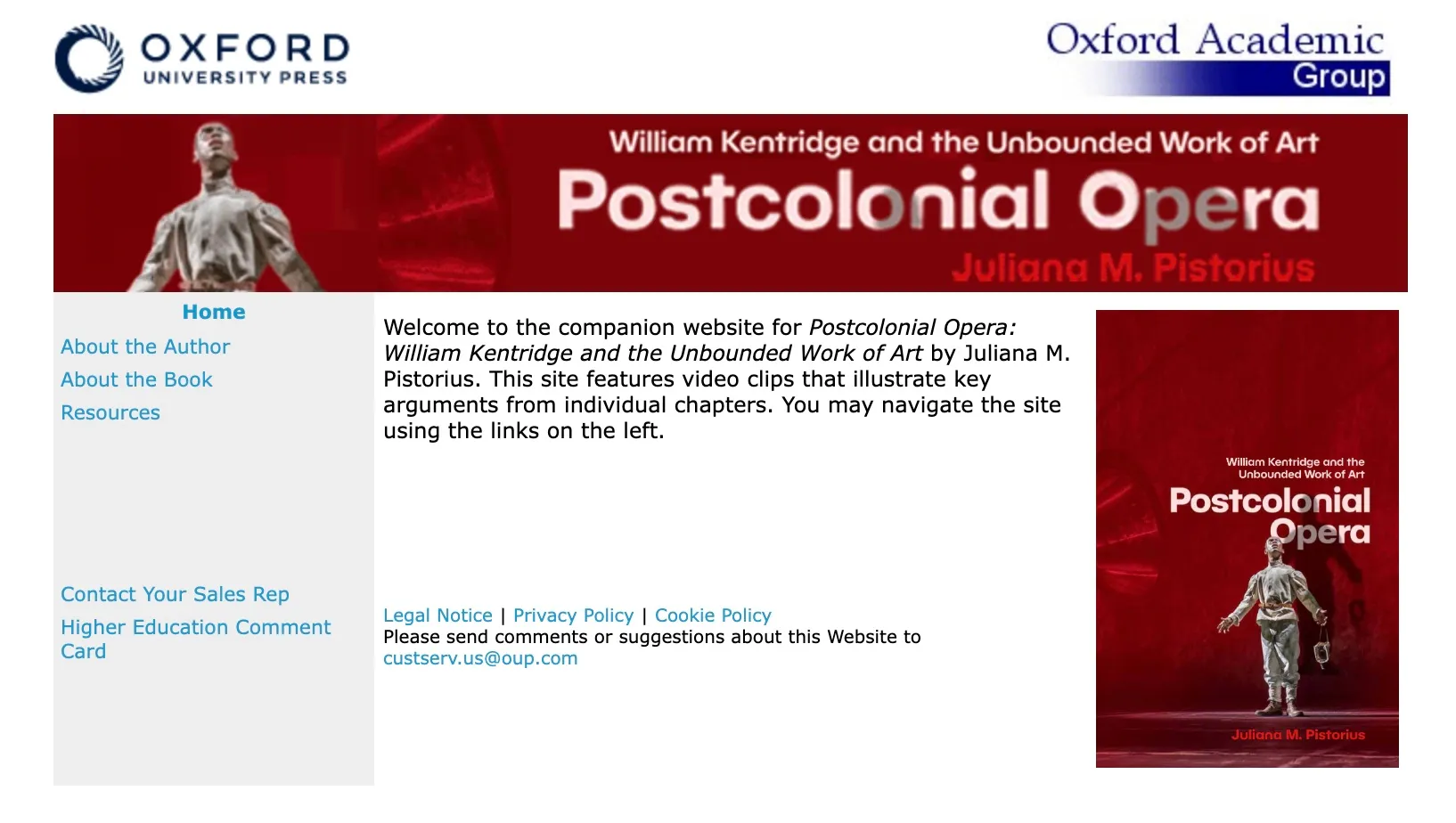
Oxford University Press created a companion website for the book, featuring short audio-visual samples tied to the text. Icons in the book signal when to view or listen online.
Curator: Bora Pajo
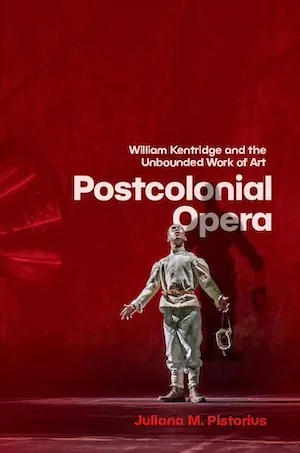
Postcolonial Opera
Juliana M. Pistorius Postcolonial Opera: William Kentridge and the Unbounded Work of Art Oxford University Press 304 pages, 6.35 x 9.17 inches ISBN 978-0197749210
Available here →September 12, 2025
20250912-pistorius-juliana-on-postcolonial-opera-3
A close-up
The rest of this thread

Juliana M. Pistorius
Juliana M. Pistorius is a Marie Skłodowska-Curie Global Research Fellow at the Institute of Advanced Studies, University College London. She has held research fellowships at the University of Huddersfield, Wits University, and Africa Open Institute of Music, Research, and Innovation. She is a founding member of the Black Opera Research Network.
Pull this thread
All opera is postcolonial, but opera cannot be decolonial.
Know something the rest of us don't?
Most threads on Rorotoko begin with our invitation. Any thread can begin with a proposal: you write it with the same prompts every thread answers, and we review it.
Propose a thread →