
Rasmus Rosenberg Larsen
Psychopathy Unmasked
Psychopathy Unmasked is a book about “psychopaths.” But it’s not your ordinary run-of-the-mill account that repeats the well-worn story of violent people naturally disposed to wreak havoc in our society.
Instead, Psychopathy Unmasked is both investigative scientific criticism and criminal justice activism. More uniquely, it’s actually the first book ever to take a sustained critical look at the science of psychopathy and how the legal system has used—and, I argue, misused—the diagnosis.
To give you a cohesive sense of my book, I should first sketch some background information: Most people have some sense of what terms “psychopath” or “psychopathy” means. When I use these terms, perhaps you picture a serial offender who has no empathy or sense of social responsibility; someone who cares only for themselves. This image has been popularized in films like Anton Chigurh in No Country for Old Men or Hannibal Lecter in The Silence of the Lambs. I’m sure you have your own favorite example. My students love to watch Dexter, a story about a psychopath who uses his callous personality to do good by killing bad guys.
While many of these fictional depictions are caricatures of psychopathy, they are not completely far from how the term is used in clinical and legal settings. In practice, psychopathy—or Psychopathic Personality Disorder as it is also called—is a diagnostic label applied to individuals with certain callous and unemotional traits and antisocial tendencies. For those who are interested in clinical formalities, psychopathy is commonly seen as a severe subtype of Antisocial Personality Disorder. These are the formalities, but here is where it becomes both really interesting and ethically complicated. In the 1990s, and presumably as part of the “get tough on crime” movement, our criminal justice system slowly began to systematically screen justice-involved individuals for psychopathy. It started with a couple of hundred screenings each year, where today the practice has ballooned to tens or maybe hundreds of thousands yearly assessments in the U.S. and Canada.
On top of this, the diagnosis also became highly influential in legal decisions, a status that it still enjoys today. Once someone is diagnosed with psychopathy, the consequences can be severe, such as increasing the likelihood of non-mitigated sentences, denial of parole, placement in high-security prisons, juvenile transfer, and the diagnosis remains one of the preferred avenues for prosecutors to argue in favor of capital sentencing over life without parole. Well, ok, and so what, you might think. Isn’t this a good development? Some people have indeed argued that it is a good thing, that we should expect our legal system to do this; to systematically figure out which offenders are the true psychopaths in our society. We are told that these individuals are the “worst of the worst.” So why not treat them accordingly with targeted intervention? If we restrict psychopaths’ ability to roam freely, the argument goes, society will become a safer place. If you find this argument convincing and even reasonable, then I fully understand. I did so too when I first took interest in this topic back in 2012. But as I began to study it more carefully, I quickly discovered that things are a bit more complicated. What I discovered was that for decades, scientists have tested whether individuals diagnosed with psychopathy truly fit the “boogeyman” image that is part and parcel of the psychopathy diagnosis. The findings are striking: they don’t fit the image. People diagnosed with psychopathy are not meaningfully more violent than other offenders, nor do they reliably lack empathy or impulse control. Basically, all the common claims that are made about psychopaths have never been corroborated by empirical research.
Yet despite this, psychopathic persons are still being treated differently in the criminal justice system, as the diagnosis introduces serious bias into decision-making. In Psychopathy Unmasked, I lay out the case for why we must stop using this diagnosis to shape legal outcomes.
Curator: Bora Pajo
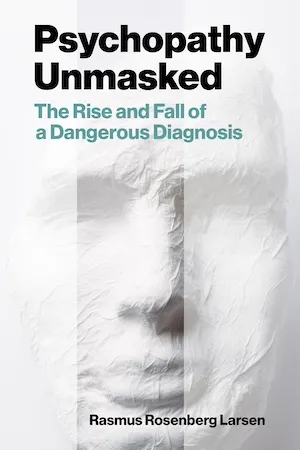
Psychopathy Unmasked
Rasmus Rosenberg Larsen Psychopathy Unmasked: The Rise and Fall of a Dangerous Diagnosis MIT Press 328 pages, 6 x 9 inches ISBN 9780262552202
Available here →September 15, 2025
20250915-larsen-rasmus-on-psychopathy-unmasked-1-1
In a nutshell
The rest of this thread
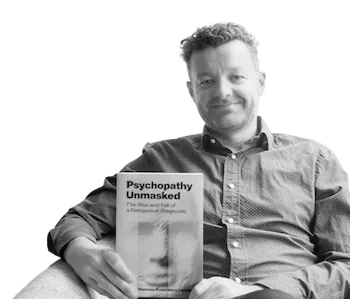
Rasmus Rosenberg Larsen
Rasmus Rosenberg Larsen (PhD) is an Assistant Professor of Forensic Epistemology and Philosophy of Science at theUniversity of Toronto Mississaugaand an Affiliated Scientist at theNational Center for Ontological Research. His work lies at the intersection of psychology, epistemology, and law, with research published in top-tier journals such asThe Lancet: Psychiatry;Psychology, Public Policy, and Law; andPhilosophical Psychology. He is the author ofPsychopathy Unmasked: The Rise and Fall of a Dangerous Diagnosis(MIT Press).
Pull this thread
People diagnosed with psychopathy are not meaningfully more violent than other offenders.
Know something the rest of us don't?
Most threads on Rorotoko begin with our invitation. Any thread can begin with a proposal: you write it with the same prompts every thread answers, and we review it.
Propose a thread →