
Rasmus Rosenberg Larsen
Psychopathy Unmasked
At its core, Psychopathy Unmasked is a work of skepticism. Psychopathy is unquestionably one of the most culturally captivating mental health diagnoses. It pervades crime thrillers and true-crime narratives, making it easy to accept the diagnosis as real and its traits as self-evident.
But being a scientist means letting the evidence lead. And the empirical evidence simply does not support any of the most common claims made about psychopathy. There are hundreds of well-designed studies, yet the picture that emerges consistently undermines the mainstream narrative. The actual scientific story about psychopathy is truly a story untold, eclipsed by a myriad of false and tantalizing narratives. And the story from the legal side of things —about hearing the voices from the people harmed by the stigma of the diagnosis—is thoroughly silenced. So, the project of writing Psychopathy Unmasked stems from being personally bothered by how so many people are getting the science of psychopathy wrong. But equally so, when I realized the magnitude of the harm caused by the diagnosis in the legal system. To be honest, this skepticism about psychopathy didn’t emerge overnight. In the early stages of my career, I was just as intrigued by the idea of psychopathy as most people. But as I immersed myself in the research, I kept encountering all sorts of truly questionable research as well as studies whose findings didn’t match the prevailing narrative. Some results were inconsistent, others relied on questionable methods, and the strongest claims seemed to be the least well-supported. Over time, curiosity turned into an ethical concern: how had such a questionable diagnosis become so deeply entrenched in the criminal justice system?
As I was shaping my book project, I came to realize that my work is just as much a part of a larger conversation about how we use science in legal contexts. This book is therefore much more than a simple criticism of a single diagnosis: it’s about ensuring that the tools and concepts shaping people’s lives in courtrooms and correctional facilities are grounded in robust, transparent scientific evidence. I therefore hope readers approach Psychopathy Unmasked with curiosity, but also with a willingness to challenge deeply held assumptions. It’s an invitation to rethink what we believe we “know” and to re-examine the ways science is deployed in the pursuit of justice.
Curator: Bora Pajo
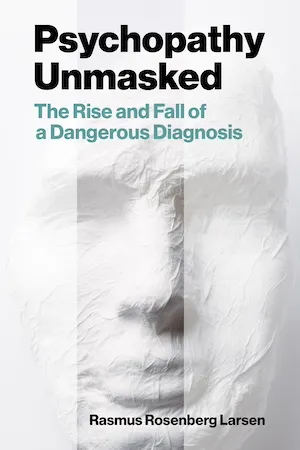
Psychopathy Unmasked
Rasmus Rosenberg Larsen Psychopathy Unmasked: The Rise and Fall of a Dangerous Diagnosis MIT Press 328 pages, 6 x 9 inches ISBN 9780262552202
Available here →September 15, 2025
20250915-larsen-rasmus-on-psychopathy-unmasked-2
The wide angle
The rest of this thread
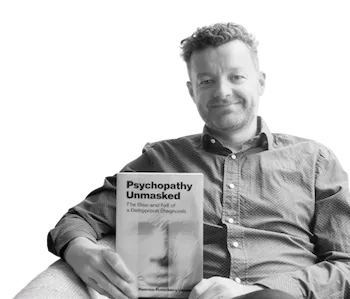
Rasmus Rosenberg Larsen
Rasmus Rosenberg Larsen (PhD) is an Assistant Professor of Forensic Epistemology and Philosophy of Science at theUniversity of Toronto Mississaugaand an Affiliated Scientist at theNational Center for Ontological Research. His work lies at the intersection of psychology, epistemology, and law, with research published in top-tier journals such asThe Lancet: Psychiatry;Psychology, Public Policy, and Law; andPhilosophical Psychology. He is the author ofPsychopathy Unmasked: The Rise and Fall of a Dangerous Diagnosis(MIT Press).
Pull this thread
pulls againstpulls alongside
People diagnosed with psychopathy are not meaningfully more violent than other offenders, and the diagnosis should leave legal use.
Against AR · Nihilism is true, because science cannot justify the morality nearly everyone accepts, and it is harmless. On: Mental life reduces to states of the brain
Against GH · Language is many nested processing routines rather than one faculty, and the dual stream model is the organizing fact. On: Psychiatric categories name conditions that exist independently of the classifying practice
Against EB · Mutual-aid structure makes radical religious groups lethal, so governments should compete with them in providing benign services. On: A practice that persists over long periods does so because it works
Against TG · What we want from film, love, violence, hide-and-seek, the supernatural, comes from innate mammalian and hunter-gatherer dispositions. On: Mental life reduces to states of the brain
Alongside JK · Natural science cannot settle judicial, legislative or personal questions, because those rest on ethical premises evidence cannot supply. On: Mental life reduces to states of the brain
Alongside SA · American biological psychiatry descends by a traceable line from the eugenic tradition that produced the Nazi euthanasia programs. On: Psychiatric categories name conditions that exist independently of the classifying practice
Alongside TM · The welfare queen survives because stories demand antagonists, detail and resolution, and only better-told stories can dislodge her. On: A practice that persists over long periods does so because it works
Alongside JM · You cannot explain how anyone sees a painting or understands a novel without first settling what a self is. On: Mental life reduces to states of the brain
Know something the rest of us don't?
Most threads on Rorotoko begin with our invitation. Any thread can begin with a proposal: you write it with the same prompts every thread answers, and we review it.
Propose a thread →