
Josephine Hoegaerts
Speaking, Stammering, Singing, Shouting
Speaking, Stammering, Singing, Shouting is about what people sounded like in the nineteenth century. It doesn’t spotlight the brilliant voices of the stage or the famous voices of public figures. Instead, it focuses on the everyday vocal interactions of ‘normal’ people. To establish what was considered ‘normal’ for a modern European voice, the book offers a deep dive into the norms for speech and song, how these norms were set, and how people learned to adhere to them. The nineteenth century produced a surprisingly wide array of publications by experts in search of the healthy, pleasant, normal voice. For my research, I drew on this impressive stream of scientific essays, educational manuals, therapeutic methods and auto-biographical self-help books that came out of the increasingly professionalized field of vocal knowledge. The book features French physiologist Édouard Fournié, for example, whose research on the human larynx or voice-box prompted him to offer a stringent, almost mathematical explanation for gendered vocal norms: a man’s voice-box was “more developed and more prominent”, with cartilage forming “acute angles” that resulted in the robust masculine voice. Women’s cartilage was “rounded,” which reflected their general softness and curves—and produced similarly feminine sounds.
The book shows how experts like Fournié articulated social and cultural ideals for vocal sounds, like the expectation that men’s voices were more prominent and women’s more rounded, in the language of anatomical, physiological or educational objectivity. As both social expectations and technological possibilities changed throughout the century, what Europeans sounded like when they opened their mouths, changed as well.
The book’s narrative centers on a key turning point: the invention of the laryngoscope and the discovery of the brain’s language center, both around 1860. These breakthroughs revealed what had always been deeply mysterious: the production of voice within the body. The laryngoscope allowed doctors and singers alike to peer into a living, moving throat to see the vocal folds at work. The identification of an area for speech in the brain allowed them to precisely locate where all the sounds produced in the throat initially originated. These discoveries fundamentally changed the status of the human voice. For centuries, it had been imagined as an eerie, invisible force. But now, locatable in particular parts of the body, the voice became a tangible, material ‘thing’ to be observed, manipulated and perfected. The voice therefore became one of the many tools individuals had at their disposal to achieve social propriety. It also became one of the many bodily features that could lead them to social failure, if they did not manage to exert control over them.

Lithograph of Ninad’Aubigny von Engelbrunner (est. 1806), courtesy of Gallica, Bibliothèquenationale de France.
Curator: Bora Pajo
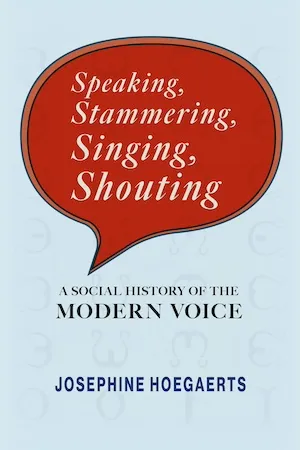
Speaking, Stammering, Singing, Shouting
Josephine Hoegaerts Speaking, Stammering, Singing, Shouting: A Social History of the Modern Voice University of Pennsylvania Press 280 pages, 6 x 9 inches ISBN 9781512827736
Available here →September 29, 2025
20250929-josephine-hoegaerts-on-speaking-stammering-singing-shouting-1-1
In a nutshell
The rest of this thread

Photograph by Kirsten van Santen
Josephine Hoegaerts
Josephine Hoegaerts is a Professor of European Culture after 1800 at the Department of History, European Studies and Religious Studies of the University of Amsterdam. She has published widely on the histories of practices of citizenship, embodied experiences of political representation, and vocal norms and practices in nineteenth century Europe. From 2018-2023, she led the research project ‘Vocal Articulations of Parliamentary Identity and Empire’, on the development of political speech in the French and British empire. Apart from Speaking, Stammering, Singing, Shouting, she is also the author of Masculinity and Nationhood 1830-1910, published in 2014.
Pull this thread
The nineteenth century's natural voice hid rigid norms behind the language of anatomy.
Know something the rest of us don't?
Most threads on Rorotoko begin with our invitation. Any thread can begin with a proposal: you write it with the same prompts every thread answers, and we review it.
Propose a thread →