
Josephine Hoegaerts
Speaking, Stammering, Singing, Shouting
My interest in the sounds of historical voices grew out of my earlier research on masculinity in the nineteenth century. Rooting through the archives of schools, military barracks and legislative chambers, I noticed something striking. These places were built around sound—and especially vocal sound. People gave orders by shouting. They expressed joy through exclamations and song. Dissent was marked by noise and obedience by silence. Most of all, people expressed individuality through speech – not (or not exclusively) by what they said, but by their tone, the warmth of their timbre, the rhythm of their consonants. Generals were remembered for their fatherly tones, politicians ridiculed for their flutey voices. While historians had almost entirely ignored the vocal sounds that carried modern discourse, historical actors in the nineteenth century clearly cared about what their contemporaries sounded like.
Speaking, Stammering, Singing, Shouting brings these vocal sounds back into focus. It also demonstrates that it is possible to write histories that recognize the cultural work of vocality, even when all the documents we have left are silent. One of the things I found important to show, by writing such a history, is the inherently political nature of talk. No matter how much effort educators put into encouraging the development of a natural voice (and in the nineteenth century, that effort was significant), the resulting norms and expectations for vocal health and normality reflect the social and political distinctions of their time.
Seeing the definition of the natural voice develop and change over time also places significant question marks around notions of natural talent – whether that is a talent for fluency, song, or even simply a pleasant tone. Talent is thereby revealed as, ultimately, a practice of assimilation that is intimately connected to social status and power.
Work in disability studies, especially around dysfluency, has shaped my thinking here. Joshua St. Pierre’s Cheap Talk, for example, puts the stammerer at the center of a critique of capitalism’s demand for fluent speech. His work helped shape one of the key arguments of this book. The shift from the polished, trained voice of the eighteenth century to the ‘natural’ voice of the modern era didn’t make vocal norms more flexible. It simply disguised their rigidity in new language.

Lithograph of Ninad’Aubigny von Engelbrunner (est. 1806), courtesy of Gallica, Bibliothèquenationale de France.
Curator: Bora Pajo
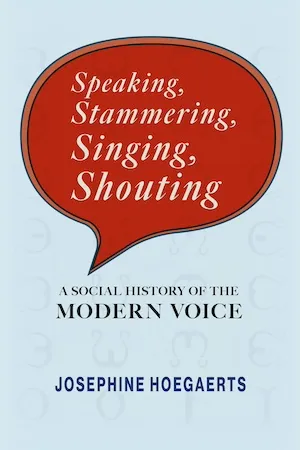
Speaking, Stammering, Singing, Shouting
Josephine Hoegaerts Speaking, Stammering, Singing, Shouting: A Social History of the Modern Voice University of Pennsylvania Press 280 pages, 6 x 9 inches ISBN 9781512827736
Available here →September 29, 2025
20250929-josephine-hoegaerts-on-speaking-stammering-singing-shouting-2
The wide angle
The rest of this thread

Photograph by Kirsten van Santen
Josephine Hoegaerts
Josephine Hoegaerts is a Professor of European Culture after 1800 at the Department of History, European Studies and Religious Studies of the University of Amsterdam. She has published widely on the histories of practices of citizenship, embodied experiences of political representation, and vocal norms and practices in nineteenth century Europe. From 2018-2023, she led the research project ‘Vocal Articulations of Parliamentary Identity and Empire’, on the development of political speech in the French and British empire. Apart from Speaking, Stammering, Singing, Shouting, she is also the author of Masculinity and Nationhood 1830-1910, published in 2014.
Pull this thread
The nineteenth century's natural voice did not loosen vocal norms, it disguised their rigidity as anatomy.
Know something the rest of us don't?
Most threads on Rorotoko begin with our invitation. Any thread can begin with a proposal: you write it with the same prompts every thread answers, and we review it.
Propose a thread →