
Josephine Hoegaerts
Speaking, Stammering, Singing, Shouting
The book attempts to give equal billing to scientific debates and educational practice in music and oracy. Different parts of the narrative are therefore likely to appeal to readers interested in voice education, speech therapy, the history of science, or cultural history. For me, however, all these elements are intrinsically interwoven in the social history of voice: aesthetic ideals and scientific norms for vocal health worked together to produce the expectations for different individuals to produce ‘proper’ vocal sounds, that matched their identity and social status.
It’s the sections that highlight the less conventional of these individuals that I have enjoyed writing the most. For all its rigidity and aspirations of rationality and propriety, the nineteenth century excelled at producing eccentrics. The then still highly unregulated field of expertise on vocal health and beauty does not disappoint in this regard. Interspersed between the more analytical chapters on changes in how the voice was made visible, how it was cultivated for social and professional use, and how it was located in the brain, are brief intermezzi highlighting the experiences of pioneering laryngoscopists, voice teachers, stammerers and even talking monkeys.
One of these remarkable figures is the now largely forgotten Nina d’Aubigny. In her own time, around the turn of the nineteenth century, she was a rare female authority on vocal education – a precursor perhaps to the now heavily female dominated fields of speech therapy and vocal pedagogy. Miss d’Aubigny was a woman of strong opinions, one of which was that women were not only not inferior to men when it came to cultivating young voices, but that they were in fact especially suited to the task. She advocated for a vocal pedagogy founded on principles of both modern science and good taste, which she believed would be “influential for the physical and moral education of the female sex”, and ultimately of benefit for society at large. Anticipating the professionalization of vocal expertise later in the century, d’Aubigny happily blurred any divisions between the musical and the scientific, or the experimental and the pedagogical. In pursuit of the proper voice, questions of taste, authority and health were intertwined.
In writing this book, I wanted to do two things.
On the one hand, I wanted to provide current professionals in fields related to vocal health and education with a nuanced history of their fields of expertise. The stories of speech therapy, vocal pedagogy, speech language pathology, and other specializations related to speech and song tend to be told as stories of linear progress. Consecutive discoveries and inventions can easily be read as signs of ongoing improvement, but such interpretations often ignore the significant cultural and social work that has informed the ideals and norms that drove those discoveries in the first place. This book also tells the story of the failed experiments, the over-hyped cures, and the forgotten practitioners of now long-lost methods that also shaped these fields of expertise.
On the other hand, the book also aims to be a call to action for social, cultural and political historians to engage in more archival eavesdropping. My research demonstrates that the human voice was central to everyday life and history. Voices influenced decisions, shaped relationships, and expressed emotions, whether through a political speech, a lullaby, a heated argument, or a whispered secret. Even in the nineteenth century, often seen as dominated by print, people were deeply invested in how they spoke, as is obvious in the popularity of vocal training books and guides to healthy speech. The book’s wider aim is therefore to inspire researchers to include voices in discussions about a large variety of histories, on topics ranging widely from childhood and sexuality to nationalism, fear, and death.

Lithograph of Ninad’Aubigny von Engelbrunner (est. 1806), courtesy of Gallica, Bibliothèquenationale de France.
Curator: Bora Pajo
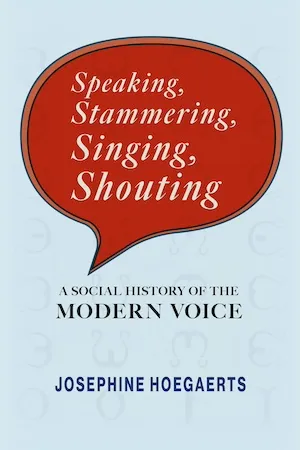
Speaking, Stammering, Singing, Shouting
Josephine Hoegaerts Speaking, Stammering, Singing, Shouting: A Social History of the Modern Voice University of Pennsylvania Press 280 pages, 6 x 9 inches ISBN 9781512827736
Available here →September 29, 2025
20250929-josephine-hoegaerts-on-speaking-stammering-singing-shouting-3
A close-up
The rest of this thread

Photograph by Kirsten van Santen
Josephine Hoegaerts
Josephine Hoegaerts is a Professor of European Culture after 1800 at the Department of History, European Studies and Religious Studies of the University of Amsterdam. She has published widely on the histories of practices of citizenship, embodied experiences of political representation, and vocal norms and practices in nineteenth century Europe. From 2018-2023, she led the research project ‘Vocal Articulations of Parliamentary Identity and Empire’, on the development of political speech in the French and British empire. Apart from Speaking, Stammering, Singing, Shouting, she is also the author of Masculinity and Nationhood 1830-1910, published in 2014.
Pull this thread
The nineteenth century's natural voice did not loosen vocal norms, it disguised their rigidity as anatomy.
Know something the rest of us don't?
Most threads on Rorotoko begin with our invitation. Any thread can begin with a proposal: you write it with the same prompts every thread answers, and we review it.
Propose a thread →