
Michael Leja
A Flood of Pictures
Pictures of all kinds in all media are so omnipresent, so naturalized in our 21st-century lives that a world without them is hard to imagine. Yet the picture-saturated culture we know today has a relatively short history. It began about two hundred years ago, when the mass production and mass marketing of pictures became viable and desirable. A Flood of Pictures tells the story of this development as it unfolded in the United States between about 1830 and 1860. At that time pictures began to permeate most areas of ordinary daily experience, and this transformed social and cultural life.
The book is written as a series of narratives. It identifies seven projects that were instrumental to the remaking of picture production for mass distribution in the US. Each project is the focus of a chapter. The first discusses the cheap newspapers of the 1830s—the penny press—whose publishers increased sales by providing illustrations of noteworthy events, such as fires, shipwrecks, and sensational crimes. In 1840 the political campaign of Whig presidential candidate William Henry Harrison was the first to rely heavily on pictures of the candidate, shown in portraits and in various scenarios. He trounced his opponent in the election. A profusely illustrated bible published in installments between 1843 and 1846 by the Harper Brothers in New York sold almost 100,000 copies and inspired a host of followers. Hundreds of thumbnail pictures drawn very simply in a style developed for children’s publications were the key to its success. The fourth chapter spotlights a large group portrait of the US Senate, with each politician’s face copied from a photograph. It provoked international demand that exceeded the limits its engraved metal plate could supply. Jenny Lind, a Swedish singer making a concert tour through the United States in 1850, was the first entertainer to become a national celebrity thanks in part to a string of portraits in all media orchestrated by her tour promoter, P. T. Barnum. The Langenheim brothers, photographers working in Philadelphia, introduced a series of technical innovations and marketing schemes that led to the development of mass-marketable forms of photography in the 1850s. And finally, Gleason’s Pictorial was the first magazine to successfully adapt for US audiences the revolutionary model pioneered by the Illustrated London News a decade earlier. It paved the way for enduring, influential followers, including Harper’s Weekly and Frank Leslie’s Illustrated News.
I believe this is the first study to propose a canon of significant projects that defined the formative period of the nation’s mass market for images. The choice of these case studies was governed by published commentaries from the period. The popular press referenced them for their striking success in the marketplace and their influence on aspiring picture makers. The case studies also represent as fully as possible a cross-section of the media, subject matter, and functions that combined to constitute the pictorial flood.
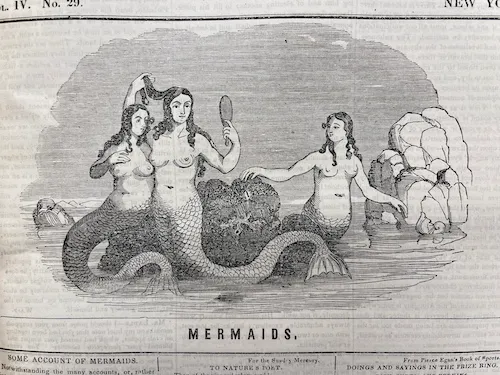
<strong id="">Mermaids</strong>. Sunday Mercury (New York), July 17, 1842, p. 1. Wood engraving, artist(s) unidentified. Library of Congress, public domain.
Curator: Bora Pajo
A Flood of Pictures
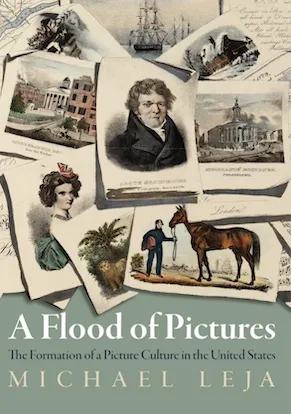
Michael Leja A Flood of Pictures: The Formation of a Picture Culture in the United States University of Pennsylvania Press 400 pages, 7 x 10 inches, ISBN 978-1512826807
Available here →October 6, 2025
20251006-michael-leja-on-flood-of-pictures-1-1
In a nutshell
The rest of this thread

Michael Leja
Michael Leja is a leading historian of American visual culture whose work spans painting, sculpture, photography, film, and print media of the 19th and 20th centuries. His scholarship explores how visual artifacts intersect with cultural, social, political, and intellectual currents, with a particular focus on the dynamic relationships between art and its audiences.He is the author of Reframing Abstract Expressionism: Subjectivity and Painting in the 1940s (1993), which won the Smithsonian’s Charles Eldredge Prize, and Looking Askance: Skepticism and American Art from Eakins to Duchamp (2004), awarded the Modernist Studies Association Book Prize. His most recent book, A Flood of Pictures: The Formation of a Picture Culture in the United States (2025), traces the emergence of mass-produced images in the mid-19th century and their transformative effects on American cultural life.Leja has been recognized with a Guggenheim Fellowship (2008) and the College Art Association’s Distinguished Teaching of Art History Award (2025). He is serving as the Leonard A. Lauder Distinguished Scholar in Residence at the Metropolitan Museum of Art in 2025–2026.
Pull this thread
Photography did not cause the flood of pictures, the pressure for images came first and technology enabled it.
Know something the rest of us don't?
Most threads on Rorotoko begin with our invitation. Any thread can begin with a proposal: you write it with the same prompts every thread answers, and we review it.
Propose a thread →