
Michael Leja
A Flood of Pictures
As an art historian I have been especially interested in works of visual art that have played some significant part in public conversations about pressing issues. In an earlier book I examined the paintings of Jackson Pollock and the Abstract Expressionists as elements of a culture-wide initiative to reimagine the self at a time when established beliefs about human nature and the human condition were coming to seem inadequate. Another book addressed the skeptical manner of seeing that developed as a social survival skill among Gilded Age Americans. How did artists respond to an audience of suspicious viewers? In such interpretative frameworks, fine art and mass visual culture often turn out to have more in common than not, and the already unstable boundaries between them fade.
A Flood of Pictures shares the concerns of these earlier studies insofar as it examines the material, social, and cultural conditions that fostered the mass production of pictures and were transformed by it. One issue that can serve as an example is the formation of mass markets. Any intrepid artist/entrepreneur in the mid-19th century US seeking to circulate fifty thousand copies or more of an image would have had to envision a demographic market of that size. This was no small challenge, given the radically heterogeneous and fractured population of the country, with vast differences in political or religious affiliation, ethnicity, rural or urban habitation, region, occupation, cultural and educational background, and class. In most cases at this time, Indigenous Americans, anyone of African or Asian heritage, and immigrants from many European nations were excluded from the target audiences envisioned for mass-marketing. In fact, much mass-produced imagery during this period was overtly racist and xenophobic, and it served effectively to reinforce the prejudices and exclusions already in place. Even within the limited diversity of envisioned audiences significant differences had to be overcome, and questions of inclusion and exclusion were essential. The case studies reveal that the mass audiences forged for these projects were different. They generated not one mass audience but many. Each project targeted a particular array of population groups with telling inclusions and exclusions. Not in all cases were the calibrations to certain groups explicit, but implicit ones were always in play.
One approach to this challenge entailed designing and marketing images in ways that avoided alienating any segment of the population that might have an interest in their content. Failure in this line was inevitable, but the ambition was resilient, and limited success was possible, as the example of Harper’s Bible illustrates. Another option was to exploit differences in the national population by rallying one part against a demonized other. The Whig campaign images produced for Harrison’s presidential campaign in 1840 abandoned established, unifying symbols of the nation in favor of personal symbols that drove a wedge into the electorate. A third alternative was carefully manipulating component populations through clever promotional schemes. Deep class divisions could be left in place while multifaceted marketing strategies appealed to different groups. The painstaking management of Jenny Lind’s image epitomizes this approach.
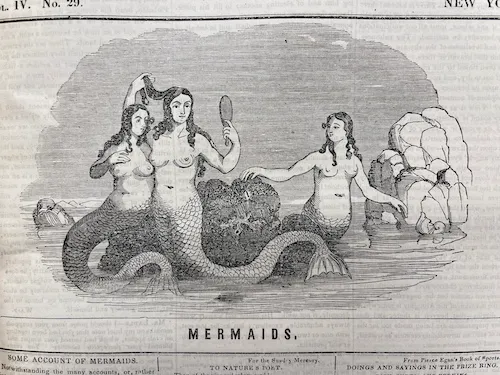
Mermaids . Sunday Mercury (New York), July 17, 1842, p. 1. Wood engraving, artist(s) unidentified. Library of Congress, public domain.
Curator: Bora Pajo
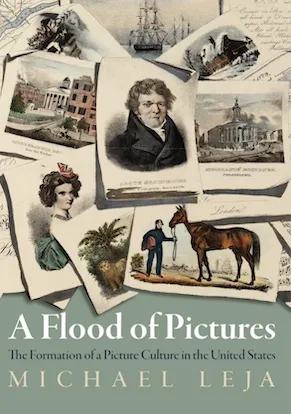
A Flood of Pictures
Michael Leja A Flood of Pictures: The Formation of a Picture Culture in the United States University of Pennsylvania Press 400 pages, 7 x 10 inches, ISBN 978-1512826807
Available here →October 6, 2025
20251006-michael-leja-on-flood-of-pictures-2
The wide angle
The rest of this thread

Michael Leja
Michael Leja is a leading historian of American visual culture whose work spans painting, sculpture, photography, film, and print media of the 19th and 20th centuries. His scholarship explores how visual artifacts intersect with cultural, social, political, and intellectual currents, with a particular focus on the dynamic relationships between art and its audiences.He is the author of Reframing Abstract Expressionism: Subjectivity and Painting in the 1940s (1993), which won the Smithsonian’s Charles Eldredge Prize, and Looking Askance: Skepticism and American Art from Eakins to Duchamp (2004), awarded the Modernist Studies Association Book Prize. His most recent book, A Flood of Pictures: The Formation of a Picture Culture in the United States (2025), traces the emergence of mass-produced images in the mid-19th century and their transformative effects on American cultural life.Leja has been recognized with a Guggenheim Fellowship (2008) and the College Art Association’s Distinguished Teaching of Art History Award (2025). He is serving as the Leonard A. Lauder Distinguished Scholar in Residence at the Metropolitan Museum of Art in 2025–2026.
Pull this thread
Photography did not cause the flood of pictures, the pressure for images came first and technology enabled it.
Know something the rest of us don't?
Most threads on Rorotoko begin with our invitation. Any thread can begin with a proposal: you write it with the same prompts every thread answers, and we review it.
Propose a thread →