
Roger Crowley
Spice
The content of my book is very much what the title proclaims: ‘Spice: The 16th-Century Contest that shaped the Modern World’. The sixteenth century was a break point in the acceleration of human exploration and our understanding of the planet. Columbus was a forerunner, followed by Vasco da Gama and a dynamic age of maritime discovery. In the process it witnessed a knowledge explosion through the medium of printing and cartography. The catalyst for this was the spice trade.
It’s hard for us now, as we look at our spice racks, to understand what all the fuss was about. The lure of spices reaches far back into antiquity; 4000-year-old clove buds have been excavated from cities on the banks of the Euphrates. Across millennia, spices have been valued as antiseptics, analgesics, and aphrodisiacs, to cheer up food and drink and as intimations of paradise. They were traded across vast distances by sea. Parallel to the Silk Road there was a maritime spice route that transported spices through the hands of many merchants, from the furthest east, across the Indian Ocean and into Europe. They were the ideal long-distance cargo: lightweight, highly valuable and reasonably imperishable. Before the Europeans came, the spice business was a peaceful trading commonwealth. It saw the spread of Islam into the Indian subcontinent, created powerful kingdoms and enriched Venice: by the time spices reached Europe, they were extremely expensive, as much as a 1000% mark up from source.
It was the desire to acquire spices at source and cut out the middlemen that set the Portuguese and the Spanish on their so-called ‘voyages of discovery’. Their ultimate objective was a scatter of small islands in the Philippine archipelago, the only places on earth where the most desirable spices, cloves and nutmeg, grew. My book chronicles their extraordinary, and often ghastly, voyages and the attempts to monopolize the trade that resulted in a bitter micro-war between the two countries on the other side of the world.
The race for the spice islands set in motion a chain of long-term consequences: the exploration of the Pacific Ocean; then the first contacts with China and Japan. In the process we see the development of a world-wide trading system and the creation of a global currency – silver – that allowed goods and technologies to circulate around the world: it made it possible to buy Ming pottery in Amsterdam and it introduced firearms into Japan.
Curator: Bora Pajo
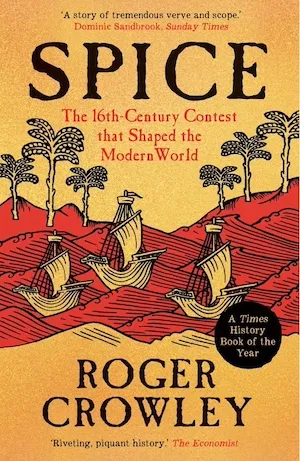
Spice
Roger Crowley Spice: The 16th-Century Contest that Shaped the Modern World Yale University Press 320 pages, 6 x 9 inches, ISBN 978-0300267471
Available here →October 9, 2025
20251009-crowley-roger-on-spice-16th-century-contest-that-shaped-the-world-1-1
In a nutshell
The rest of this thread
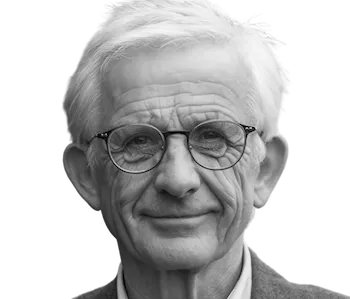
Roger Crowley
Roger Crowley is a British historian and bestselling author specializing in maritime and Mediterranean history. Educated at Sherborne School and Emmanuel College, Cambridge, he was inspired by his early experiences in Malta and later travels across the Greek-speaking world and Turkey. After a career in publishing, he turned to full-time writing, earning a reputation for vivid narrative history rooted in original sources and eyewitness accounts.Crowley’s works include A trilogy on the Mediterranean—1453: The Last Great Siege (2005), Empires of the Sea (2008), and City of Fortune (2011)—as well as Conquerors: How Portugal Forged the First Global Empire (2015), Accursed Tower: The Crusaders’ Last Battle for the Holy Land (2019), and Spice: The 16th-Century Contest That Shaped the Modern World (2024). His books have been translated into more than twenty languages.
Pull this thread
The sixteenth-century contest for cloves and nutmeg was the catalyst of globalisation.
Know something the rest of us don't?
Most threads on Rorotoko begin with our invitation. Any thread can begin with a proposal: you write it with the same prompts every thread answers, and we review it.
Propose a thread →