
Zachary Albert
Partisan Policy Networks
This book examines how many policy research organizations, like think tanks, have transformed from non-partisan information producers into partisan allies pursuing ideological policy goals. Most policymaking today is structured by “partisan policy networks” united by shared goals and mutual trust – and producing policy that is often poorly informed and unrepresentative of what the mass public wants. It is fortuitous that this book came out when it did. With the start of the second Trump Administration, people are paying attention to the profound influence of the Heritage Foundation (and other think tanks and interest groups) associated with Project 2025. Despite Trump’s disavowals, he has drawn directly from the Project 2025 playbook – a conservative to-do list aimed at reshaping (and in some cases dismantling) the administrative state. Many of Trump’s executive actions reflect ideas and language laid out in the Project.
This book provides a framework for understanding these events. In a highly polarized world, elected officials seek information and ideas to advance partisan goals. They care less about the accuracy of information and more about its utility in partisan policy debates.
A growing number of research organizations have evolved to meet this demand. These groups are themselves “policy demanders”; they seek to move legislation toward their narrow or ideological self-interests. By providing elected officials from their preferred party with key policy resources, they subsidize partisan policymaking and move it toward their preferences. But these partisan research institutions do more than just supply ideas. Increasingly, they also engage in direct advocacy to advance their objectives. Working with elected officials and other organized interests, they lobby, mobilize grassroots supporters, participate in electoral activities, and inform public conversations.
While the historical view of policy research as “above politics” was never fully accurate, what we have today is profoundly different. Partisanship increasingly structures the production and dissemination of information. Research organizations are active participants in partisan battles. And stable partisan networks, built on direct collaborations and partisan reputations, structure most modern policymaking.
These developments pose significant problems for American democracy. Partisan policy networks displace sound research in favor of partisan-motivated ideas, undermining responsible policymaking. They also move policy toward their own, often ideologically extreme preferences, biasing representation. And they prohibit dialogue and compromise between the two parties. In a system that often requires bipartisanship, partisan dynamics produce gridlock and incentivize unilateral presidential action.
Curator: Rachel Althof
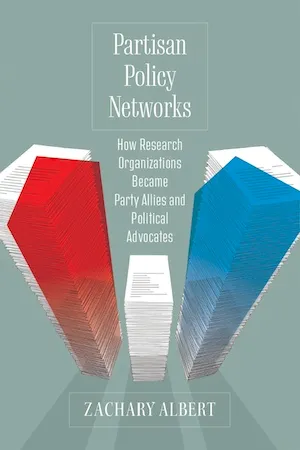
Partisan Policy Networks
Zachary Albert Partisan Policy Networks: How Research Organizations Became Party Allies and Political Advocates University of Pennsylvania Press 357 pages, ISBN:9781512828016
Available here →November 6, 2025
20251106-albert-zachary-on-partisan-policy-networks-1-1
In a nutshell
The rest of this thread

Zachary Albert
Zachary Albert is an Assistant Professor in Politics at Brandeis University. His research has been published in academic journals like Political Behavior, Party Politics, and Political Research Quarterly. He is also co-author of a forthcoming book, titled Small Donors in US Politics: Myth and Reality, with the University of Chicago Press.
Pull this thread
Policy research organizations have become policy demanders and party allies rather than producers of information.
Know something the rest of us don't?
Most threads on Rorotoko begin with our invitation. Any thread can begin with a proposal: you write it with the same prompts every thread answers, and we review it.
Propose a thread →