
Zachary Albert
Partisan Policy Networks
Early in my graduate school career I was exposed to an increasingly popular theory of political parties as “extended networks”. Proponents argue that we need to move beyond formal party organizations and elected officials and focus additionally on the constellation of organized interests, movements, and groups that align with each party. These policy demanders use parties as a vehicle to move policy in their preferred direction. They screen candidates during party nominations and support those who align with their agendas. Because most voters know or care little about policy details, these groups can select candidates who cater to their narrow interests or ideological agendas. The theory was incredibly enticing. It helps make sense of contemporary polarization in a way that previous theories failed to do. And it explains why parties often do things that seem to go against majoritarian opinion.
But I was also left wanting. The theory is all about how policy demanders use parties to get what they want from government. But most scholarship focused solely on their efforts in nomination contests. It wasn’t clear to me how these electoral activities translated into policy wins. It’s one thing to help get an anti-tax conservative elected, but another entirely to get a law passed that contains detailed, often technical changes to the tax code that benefit particular interests. The puzzle deepened when I started to learn more about Congressional policymaking. Congress increasingly lacks the resources, expertise, and desire to engage in the hard work of policymaking. Most elected officials are adept at campaigning, fundraising, and messaging, not legislating. For this reason, I turned my attention outside Congress. While the vast majority of polarization research has focused inside the legislature, there is a robust community of policy researchers and advocates outside of it. These groups had been studied, but not through an explicitly partisan lens, or nearly enough in the present era of polarization.
As I started to collect data, including through interviews with policy researchers in DC, I realized that policy research organizations were the connective tissue tying together extended party policymaking. Once sympathetic members of Congress are elected, these groups provide them with the ideas, research, and talking points to help them pass mutually agreed upon legislation. These connections are generally quite stable. Partisan trust, rather than reputations for objectivity, are increasingly the coin of the realm in the policymaking world. We can learn a great deal about contemporary policy outcomes, I found, by focusing on these partisan policy networks.
Curator: Rachel Althof
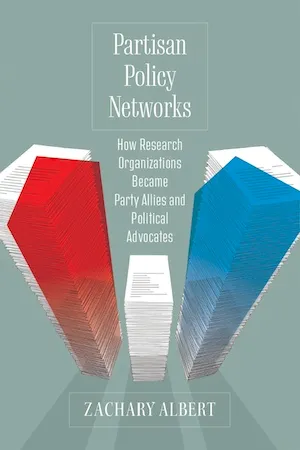
Partisan Policy Networks
Zachary Albert Partisan Policy Networks: How Research Organizations Became Party Allies and Political Advocates University of Pennsylvania Press 357 pages, ISBN:9781512828016
Available here →November 6, 2025
20251106-albert-zachary-on-partisan-policy-networks-2
The wide angle
The rest of this thread

Zachary Albert
Zachary Albert is an Assistant Professor in Politics at Brandeis University. His research has been published in academic journals like Political Behavior, Party Politics, and Political Research Quarterly. He is also co-author of a forthcoming book, titled Small Donors in US Politics: Myth and Reality, with the University of Chicago Press.
Pull this thread
Policy research organizations have become partisan policy demanders, and partisan trust has replaced objectivity as the policy world's currency.
Know something the rest of us don't?
Most threads on Rorotoko begin with our invitation. Any thread can begin with a proposal: you write it with the same prompts every thread answers, and we review it.
Propose a thread →