
Zachary Albert
Partisan Policy Networks
There is one particular example in the book that especially highlights its main themes. In 2017, the Heritage Foundation released a new edition of its “Election Fraud Database,” an empirical effort to document instances of voter fraud in American elections. The accompanying report claimed they had found 1,071 instances of voter fraud. Heritage’s takeaway from the project was simple: “voter fraud is a real and pressing issue that deserves serious solutions, and the Heritage Foundation has the evidence to prove it.”
But subsequent studies highlighted problems with the database and its conclusions. First, over the period Heritage studied, more than 3 billion votes were cast in federal elections, making the 1,071 instances of fraud a miniscule fraction of all votes. Furthermore, the Heritage report stretched the definition of “fraud” to include instances such as voters accidentally using incorrect addresses or improperly assisting others with absentee ballots. Critics argued that Heritage’s desire to push for election security measures biased its research methods and conclusions. Nevertheless, conservatives inside and outside government cited the Heritage report to support their calls for greater voter restrictions, including the institution of voter ID requirements, restrictions on mail-in voting, and the elimination of same-day registration. State legislatures introduced voter restriction legislation with language mirroring or copying Heritage proposals. And federal lawmakers cited the Heritage study to support their calls for similar interventions.
But Heritage’s efforts did not stop there. Since 2017, the think tank has updated its database, published blog posts, op-eds and books on the topic, and created state-level “Election Integrity Scorecards”. They’ve organized grassroots supporters to lobby state legislatures, and their Project 2025 blueprint has informed the Trump Administration’s efforts to reform state election laws.
As this story shows, many policy research organizations increasingly provide the research and advocacy necessary to achieve partisan objectives. They work closely with party allies in government to advance these goals. And beyond simply producing research, they engage in direct advocacy and lobbying to press their policy demands. In the process, they become trusted party allies who elected officials turn to time and again for support. In the aggregate, they represent partisan policy networks working together across issues and time. And there are potentially profound implications for American democracy: policymaking becomes more one-sided, more poorly informed, and less representative of society’s preferences.
My main hope in writing this book was that people would pay more attention to the powerful partisan and ideological biases introduced into politics by purportedly objective policy research organizations. With a better understanding of the problem, I hope that we can think about ways to support policy research that is less partisan and polarized. In the book, I explore a number of think tanks that are still conducting responsible research under accepted academic norms and procedures. The Brookings Institution is a prime example. Even some think tanks with ideological perspectives, like the libertarian Cato Institute, refrain from active partisan engagement and produce well-regarded research.
That said, more and more policy research organizations seek to advance partisan, ideological goals, and they work closely with one party to do so. As a society, we need to think about ways to elevate less biased information sources. This is decidedly un-sexy work. Good research is often boring and inaccessible. Partisan researchers often produce products that are punchy, exciting, and cognitively soothing for partisans who already agree with its conclusions. But for those who care about well-informed policymaking, these outputs often miss the mark.
I conclude the book with several concrete recommendations. Some focus on clawing back lost congressional capacity, which makes our lawmakers reliant on outsiders with narrow interests for information and ideas. Greater investments in crucial internal congressional resources, like policy experts and non-partisan researchers, would help. Outside Congress, we need to consider how these groups take advantage of – and violate – lax tax provisions that place limits or prohibitions on their lobbying and electoral activities. Investigations and punishment of such violations are exceedingly rare.
At the very least, I hope this book will help others recognize many of these research institutions for what they are: partisan subsidiaries pursuing their own self-interest.
Curator: Rachel Althof
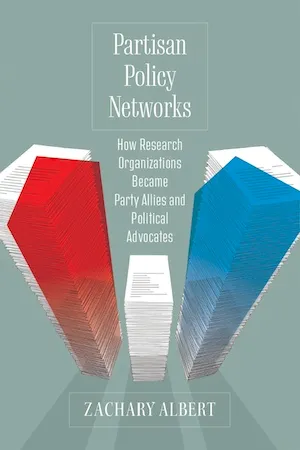
Partisan Policy Networks
Zachary Albert Partisan Policy Networks: How Research Organizations Became Party Allies and Political Advocates University of Pennsylvania Press 357 pages, ISBN: 9781512828016
Available here →November 6, 2025
20251106-albert-zachary-on-partisan-policy-networks-3
A close-up
The rest of this thread

Zachary Albert
Zachary Albert is an Assistant Professor in Politics at Brandeis University. His research has been published in academic journals like Political Behavior, Party Politics, and Political Research Quarterly. He is also co-author of a forthcoming book, titled Small Donors in US Politics: Myth and Reality, with the University of Chicago Press.
Pull this thread
Policy research organizations have become partisan policy demanders, and partisan trust has replaced objectivity as the policy world's currency.
Know something the rest of us don't?
Most threads on Rorotoko begin with our invitation. Any thread can begin with a proposal: you write it with the same prompts every thread answers, and we review it.
Propose a thread →