
Michael D. Kirchhoff
The Idealized Mind
Milk production at a dairy farm was low, so the farmer wrote to the local university, asking for help. A multidisciplinary team of professors was assembled, headed by a theoretical physicist, and two weeks of intensive on-site investigation took place. The scholars then returned to the university, where the task of writing the report was left to the team leader. Shortly thereafter, the physicist returned to the farm, saying to the farmer, "I have the solution, but it works only in the case of spherical cows in a vacuum". (https://en.wikipedia.org/wiki/Spherical_cow)
Whilst an obvious joke, the scenario highlights how physicists often make use of wildly unrealistic—idealized—assumptions with the aim of simplifying a problem to make it easier to solve. Physics is full of idealizations such as frictionless planes, massless pulleys, uniform densities, point masses, zero gravitational effects, the list goes on. Indeed, all model-based sciences—physics, chemistry, biology, neuroscience, economics, social science, etc— make widespread use of idealization techniques to build models of parts of reality. Standard examples include: the ideal gas law, frictionless planes, infinite populations, neural networks trained on unrealistic learning algorithms, infinitesimal limits, isolated populations, perfectly rational agents or philosophical zombies (a physical replica of you, yet without phenomenal consciousness). In model-based science one starts by introducing an imaginary system (e.g., a neural network using back-propagation to reduce error and optimize learning), which is investigated to understand learning in the brain. Or one might use an idealized gas, where all molecules are treated without mass and dimension, to approximate the behavior of natural gases.
The first core message of The Idealized Mind is that models of the mind and brain are idealized in precisely this way: they make use of idealized terms that have no counterpart in reality. Its second message is: despite being both simplified and idealized, models in cognitive science are still consistent with a version of scientific realism—the view that one actual and reasonable aim of science is to provide true (or, approximately true) descriptions of reality. In the book, I argue that these two messages have foundational implications for our understanding of the mind and brain based on scientific models. In cognitive science, ‘mental representation’ and ‘computation’ are fundamental theoretical concepts. Most neuroscientists and philosophers work with the assumption that the mind functions as an information-processing system, akin to a computer. Hence, the standard view in the field is that cognitive processes (e.g., perceiving or remembering or navigating) are realised by the occurrence, transformation and storage of information-bearing structures (mental representations) of one kind or another. All models of mental representation and neural representation are idealized models with no counterpart in reality. Ideal gases do not exist. Similarly, the brain does not literally compute; neurons do not send messages; nor does the brain in any literal sense process information. Constructs such as representation, computation, communication, information-processing might (and only might) be useful for modeling the mind and brain. Yet, they are nothing but abstract explanatory devices that exist mainly in the imagination of the scientific communities that use them to describe, explain, and predict aspects of the natural world.
Curator: Rachel Althof
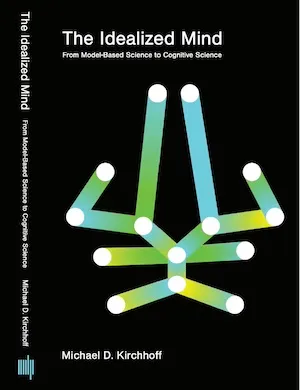
The Idealized Mind
Michael Kirchhoff The Idealized Mind: From Model-Based Science to Cognitive Science MIT Press 248 pages, 6 x 9 inches, ISBN: 9780262552936
Available here →November 13, 2025
20251113-kirchhoff-michael-on-the-idealized-mind-1-1
In a nutshell
The rest of this thread

Michael D. Kirchhoff
Michael D. Kirchhoff is an Associate Professor in the School of Liberal Arts, University of Wollongong, Australia. His current research focuses on the use of idealization in computational neuroscience and philosophy of cognitive science. Kirchhoff is the author of "The Idealized Mind: From Model-based Science to Cognitive Science" (2025) with the MIT Press. A follow-up book is in the MIT Press publication pipeline entitled "The Idealized Brain: Uniting Philosophy of Science and Computational Neuroscience" coming out in 2026. In 2024, Kirchhoff was named Field Leader in 'Philosophy' and Field Leader in 'Epistemology and Scientific History' in The Australian: Research Magazine. In addition to working of idealized modeling in the computational cognitive sciences, Kirchhoff is well-known for his interdisciplinary work integrating the highly technical and mathematical literature on free energy and active inference with current movements in the field of embodied, enactive and extended cognitive science. In this context, Kirchhoff has a co-authored book "Extended Consciousness and Predictive Processing: A Third-Wave View" published in 2019 by Routledge.
Pull this thread
Models of the mind are idealized like frictionless planes, and idealization does not buy antirealism.
Know something the rest of us don't?
Most threads on Rorotoko begin with our invitation. Any thread can begin with a proposal: you write it with the same prompts every thread answers, and we review it.
Propose a thread →