
Michael D. Kirchhoff
The Idealized Mind
All computational models of the brain and cognitive activity produced so far are either idealizations, making the models hypothetical, or approximations, making the models inexact descriptions of their target phenomena, or a mix of both. Although concepts such as neural representation, neural computation, and information processing strike many as being intimately tied to our understanding of the mind and brain, they may be no more than the idealized posits of computational neuroscience and cognitive science. Their function may be no more than idealizations such as point objects in physics and infinite populations biology. (p. 3)Bayesian models of the mind are idealizations. They are unrealistic in the same sense that postulates about infinite populations and frictionless planes are idealizations in biology and physics. (p. 7)Idealization in science has generated a lot of attention recently. A dominant view is that idealized models are akin to fictions, motivating a particular brand of fictionalism about scientific models … Fictionalism about models gives rise to a host of important questions. For example, if scientific models are fictional, and if these models are ubiquitous in science, does idealization undermine the realist quest for truth? Further issues are: Are scientific models qua abstract models merely the product of the imagination—a kind of sophisticated make-believe? Or, how can idealizations provide explanations of real-world phenomena if they are false with regard to those phenomena? These sorts of questions have received most attention in the context of mathematical models qua abstract (nonconcrete) models. In this book, I treat computational and mathematical models equally. Insofar as both types of models make use of idealizations, which they do, there is no reason why all the questions raised about the status of mathematical models cannot be raised for computational models. As I mentioned, these techniques are both in use in computational models. This should come as no surprise. Life does not evolve as it does in the Game of Life. (p. 31-32)The FEP [free energy principle) is known as a “grand unifying theory” (GUT). A GUT seeks to explain everything about the form and function of the brain by appealing to a small number of principles. GUTs are not found only in theoretical neuroscience. They are a key research goal in physics, starting with the pioneering work of Maxwell (1865). The FEP aims to provide a general theory unifying life and mind formulated entirely from mathematical principles in physics (Friston 2013; Hohwy 2020) … the FEP lends itself as a perfect case study by which to unify all the different threads covered in this book. Specifically:• The FEP is an idealized, abstract and mathematical model (chapter 1).• The FEP is not literally true of its intended target domain (chapters 2–3).• The FEP is consistent with a version of scientific realism based on the nonliteral view of idealization (chapters 3–4). • The FEP does not lend support to the RTM (chapter 5).• The FEP is a computational model yet lends no support to the CTC (chapters 6–7).• The FEP represents an extreme form of explanatory unification (chapter 8, p. 171-172)The Idealized Mind argues that when we (read: cognitive scientists, neuroscientists and philosophers of cognition) seek to explain the nature and function of the mind and brain we inevitably make use of simplified and idealized models to do so. In this specific sense, when attempting to explain the mind and brain, we idealize it in much the same way as we make use of idealizations in other sciences to explain aspects of reality. Ultimately, I would like to see much more dedicated attention to the obvious fact that models of the mind and brain are idealized models. Many of their constructs have no correspondence to biological reality. A very simple case will help illustrate the point. Leading cognitive scientists such as Gallistel and King claim that the ‘spike train’ of a neuron transmits information to other neurons or populations of neurons. This claim is false, if taken literally (read: as true). Most work in neural coding presupposes that the central unit of communication in the brain is the spike train. This is false. To see this, we need only pay attention to what a spike train is. At its core, a spike train is a series of spikes modeled over a sequence of time points, {t1, t2, …, tn}, usually depicted in the form of a peristimulus time histogram. Here is a hypothetical toy example: we set up an experiment with a fixed stimulus and measure each spike or action potential of a single neuron over ten time bins (e.g., 10ms per bin). The spike train is the trial-averaged firing rate. The reason for why trial-averaged activity of individual neurons or neural populations cannot be the vehicle of communication in the brain or the vehicle carrying around what a neuron or group of neurons represents is: a neuron or population of neurons do not, strictly speaking, receive an average firing rate (i.e., an aggregate measure or summed firing rate) as input or transmit it downstream as output. We can now ask: who is the receiver of a spike train? The answer is surprisingly simple: it is the scientists who can access the spike train as part of their modeling of neural activity. It is not the neurons. Attention to this fact alone, will and should have major implications for our interpretations from our models to facts about reality. The Idealized Mind is only a first step along this path. A completed and peer-reviewed follow-up book is already in the MIT Press production pipeline and is entitled The Idealized Brain: Uniting Philosophy of Science and Computational Neuroscience. My goal is to make the sciences of the mind and brain, a branch of science where heavy use of machine learning, artificial intelligence and opaque algorithms, more epistemically transparent.
Curator: Rachel Althof
The Idealized Mind
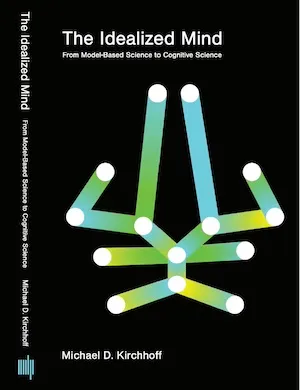
Michael Kirchhoff The Idealized Mind: From Model-Based Science to Cognitive Science MIT Press 248 pages, 6 x 9 inches, ISBN: 9780262552936
Available here →November 13, 2025
20251113-kirchhoff-michael-on-the-idealized-mind-3
A close-up
The rest of this thread

Michael D. Kirchhoff
Michael D. Kirchhoff is an Associate Professor in the School of Liberal Arts, University of Wollongong, Australia. His current research focuses on the use of idealization in computational neuroscience and philosophy of cognitive science. Kirchhoff is the author of "The Idealized Mind: From Model-based Science to Cognitive Science" (2025) with the MIT Press. A follow-up book is in the MIT Press publication pipeline entitled "The Idealized Brain: Uniting Philosophy of Science and Computational Neuroscience" coming out in 2026. In 2024, Kirchhoff was named Field Leader in 'Philosophy' and Field Leader in 'Epistemology and Scientific History' in The Australian: Research Magazine. In addition to working of idealized modeling in the computational cognitive sciences, Kirchhoff is well-known for his interdisciplinary work integrating the highly technical and mathematical literature on free energy and active inference with current movements in the field of embodied, enactive and extended cognitive science. In this context, Kirchhoff has a co-authored book "Extended Consciousness and Predictive Processing: A Third-Wave View" published in 2019 by Routledge.
Pull this thread
Models of the mind are idealized like frictionless planes, and idealization does not buy antirealism.
Know something the rest of us don't?
Most threads on Rorotoko begin with our invitation. Any thread can begin with a proposal: you write it with the same prompts every thread answers, and we review it.
Propose a thread →