
David L. Weimer
Dog Economics
People and dogs share thousands of years of co-evolution. The nature of their relationship has also evolved, moving largely from dogs as workmates to dogs as pets. Especially in contemporary American society, dogs have the unique status as both commodities and family members. Dogs can be bought and sold, yet people in a large majority of the roughly half of U.S. households with dogs consider them to be family members. Pet dogs confer great happiness on their keepers.
They provide companionship, contribute to social capital, and encourage healthier lifestyles. Yet they require expenditures of time and money for their care. They may also affect living arrangements, schedule and travel flexibility, injury risk, and even the choice of romantic partners. All dog keepers will recognize these advantages and disadvantages of our canine relationships. What does social science research tell us about these relationships? To what extent does economic theory help us understand these relationships?
In Dog Economics, we sought to answer these questions in ways that are interesting to both dog lovers and social scientists. For dog lovers, we draw on research done by veterinarians, biologists, anthropologists, psychologists, historians, legal scholars, philosophers, and even a few economists to explore what we know about dogs and our relationships with them. We interpret this diverse research from an economic perspective.
As we assume readers have no background in economics, we provide a glossary of economic terms, avoid mathematical treatment, and provide a small number of well-explained graphs. We believe our book introduces economics in a more engaging way than the typical introductory college course in economics––dogs are much more interesting than widgets!
For economists, we show how economic theory can help us better organize and interpret the growing body of social science research on our canine relationships. We draw on both neoclassical economics, which assumes that consumers do not make mistakes, and behavioral economics, which shows various ways that consumers do systematically make them.
We hope to stimulate more research by economists on the human-canine relationship. We also hope canine researchers in other disciplines find the economic concepts we introduce helpful.
If you are fond of dogs and open to learning about what social science can tell us about our canine relationships, then you should enjoy Dog Economics.

Ming in Prairie Moraine Dog Park, Verona, Wisconsin
Curator: Rachel Althof
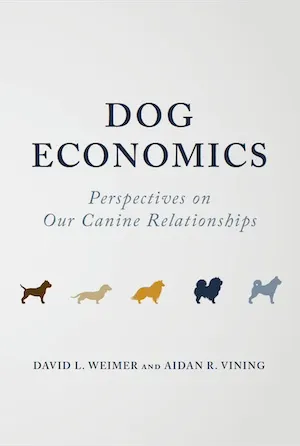
Dog Economics
David L. Weimer & Aidan R. Vining Dog Economics: Perspectives on Our Canine Relationships Cambridge University Press 216 pages, ISBN 9781009445504
Available here →November 19, 2025
20251119-david-weimer-on-dog-economics-1
In a nutshell
The rest of this thread

David L. Weimer
David L. Weimer is the Edwin E. Witte Professor of Political Economy at the University of Wisconsin–Madison. His contributions to public policy scholarship have been widely recognized: he received the Policy Field Distinguished Contribution Award from the Association for Public Policy Analysis and Management and the Outstanding Achievement Award from the Society for Benefit-Cost Analysis. He is Fellow of the National Academy of Public Administration.
Pull this thread
Know something the rest of us don't?
Most threads on Rorotoko begin with our invitation. Any thread can begin with a proposal: you write it with the same prompts every thread answers, and we review it.
Propose a thread →