
David L. Weimer
Dog Economics
We are fond of dogs. Although it would be a bit of a stretch to say that we are also fond of economics, we certainly appreciate its usefulness in understanding social interaction and informing good public policy. It was the application of economics in public policy that led us to write this book. In 2007, thousands of pet dogs and cats in the United States died from consuming pet food with an adulterated ingredient imported from China. Congress responded by giving the Food and Drug Administration (FDA) authority to regulate the quality of pet food.
At a professional meeting, the Chief Economist at the FDA complained to one of us that doing the cost-benefit analysis required to support FDA regulations of pet food was hampered because the existing research did not provide a way to monetize avoided pet deaths, the very objective of the regulation. Regulators routinely value avoided human deaths with the value of statistical life (about $10 million), which estimates the implicit value people on average place on their own life when evaluating small changes to their mortality risk, such as in accepting riskier jobs for higher wages.
Although we cannot know how dogs value changes in their own mortality risk, we can consider the implicit value their keepers place on their lives when they make decisions that affect their dogs’ mortality risks. In 2018, one of us organized a team to do a survey experiment in which a sample of dog owners were confronted with a hypothetical situation offering them the opportunity to purchase a vaccine to reduce the mortality risk their pet dogs faced from canine influenza. The responses of the dog owners allowed us to estimate that the value of statistical dog life in the United States was about $10 thousand (about $13 thousand in current dollars).
Dog lovers may certainly think this amount is too low! However, it is important to remember that this amount applies to reductions in risk––if our pooch is facing imminent death, many of us would pay much more to save her, yet we do not necessarily take all the precautions we could to reduce mortality risk before a threat to life occurs. The article reporting these results received considerable media attention. An editor suggested we build a book around it. In view of our fondness for dogs, we thought doing so would be fun. Indeed, it was.

Ming in Prairie Moraine Dog Park, Verona, Wisconsin
Curator: Rachel Althof
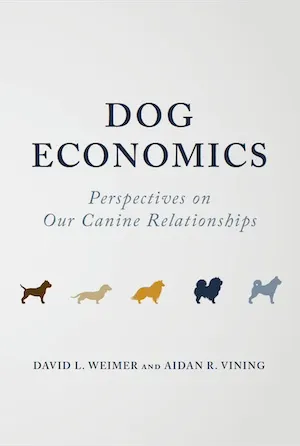
Dog Economics
David L. Weimer & Aidan R. Vining Dog Economics: Perspectives on Our Canine Relationships Cambridge University Press 216 pages, ISBN 9781009445504
Available here →November 19, 2025
20251119-david-weimer-on-dog-economics-2
The wide angle
The rest of this thread

David L. Weimer
David L. Weimer is the Edwin E. Witte Professor of Political Economy at the University of Wisconsin–Madison. His contributions to public policy scholarship have been widely recognized: he received the Policy Field Distinguished Contribution Award from the Association for Public Policy Analysis and Management and the Outstanding Achievement Award from the Society for Benefit-Cost Analysis. He is Fellow of the National Academy of Public Administration.
Pull this thread
A statistical dog life in the United States is worth about $10 thousand.
Know something the rest of us don't?
Most threads on Rorotoko begin with our invitation. Any thread can begin with a proposal: you write it with the same prompts every thread answers, and we review it.
Propose a thread →