
David L. Weimer
Dog Economics
Each chapter offers interesting research findings interpreted from an economic perspective. “Chasing the Tale” reviews what evolutionary biology tells us about the transformation of wolves into dogs. It also considers how our ancestors’ relationships with dogs involved our cooperation with them in hunting and then herding. “Love Me, Love My Dog” considers factors driving demand for dogs as pets, including the role of fads in the choice of breeds, and how these pets have come to be viewed as family members. It also interprets the increased demand for dogs during the pandemic as both a substitute for lost human companionship and the reduced opportunity costs of keeping them.
“How Much Is That Doggy in the Window” considers the supply of puppies from a diverse industry ranging from backyard breeders to abhorrent puppy mills. It explains how market failures lead to the euthanasia of almost 400 thousand dogs each year in U.S. shelters.“You Bet Your (Dog’s) Life” explains the survey experiment used to estimate the value of statistical dog life that originally motivated Dog Economics.
It considers the potential uses of this estimate, such as in determining compensation for the wrongful death of dogs and the awarding of custody of dogs in divorce settlements. “A Doggone Shame” addresses the reality that dogs have shorter lifespans than humans––most dog keepers will have to confront the end of life of their pets. It assesses changes in small animal veterinary practice resulting from the growing market for pet insurance.
It also reviews the changing norms governing the treatment of dogs in medical research. “Working for the Man” returns to the role of dogs in production. Dogs enjoy some absolute comparative advantages relative to humans and their machines, especially related to their olfactory capabilities, or they can also do service because of their relative comparative advantage. This chapter looks closely at the economics of service dogs and the controversy over the rules governing the treatment of emotional support animals by airlines.
The concluding chapter, entitled “Dogonomics,” considers how public policies can better address contemporary concerns about the treatment of dogs as well as emerging issues, such as the regulation of cloned and designer dogs, that will demand attention in the future.
Many people share our love of dogs. Economics cannot explain this love. Nonetheless, we hope our book helps dog lovers better understand the nitty-gritty of their relationships with these wonderful animals. We confess to what might be called “dog exceptionalism,” viewing the relationship between humans and dogs as special. Nonetheless, we would welcome a companion book on cat economics!

Ming in Prairie Moraine Dog Park, Verona, Wisconsin
Curator: Rachel Althof
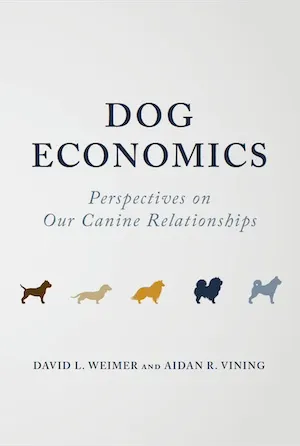
Dog Economics
David L. Weimer & Aidan R. Vining Dog Economics: Perspectives on Our Canine Relationships Cambridge University Press 216 pages, ISBN9781009445504
Available here →November 19, 2025
20251119-david-weimer-on-dog-economics-3
A close-up
The rest of this thread

David L. Weimer
David L. Weimer is the Edwin E. Witte Professor of Political Economy at the University of Wisconsin–Madison. His contributions to public policy scholarship have been widely recognized: he received the Policy Field Distinguished Contribution Award from the Association for Public Policy Analysis and Management and the Outstanding Achievement Award from the Society for Benefit-Cost Analysis. He is Fellow of the National Academy of Public Administration.
Pull this thread
A statistical dog life in the United States is worth about $10 thousand.
Know something the rest of us don't?
Most threads on Rorotoko begin with our invitation. Any thread can begin with a proposal: you write it with the same prompts every thread answers, and we review it.
Propose a thread →