
Santiago Zabala
Signs from the Future
This book explores the importance of warnings, our tendency to ignore them, and strategies to address this critical issue. I believe the 21st century is characterized by a widespread failure to heed warnings from historians, sociologists, or scientists. Decades ago, for example, we were warned about pandemic influenza, the rise of far-right populism, and the dangers of AI. But why didn’t we listen? The answer isn’t just due to inaccurate data or fake news, as many think. It’s more complex. The most interesting part of warnings isn’t just how indifferent we’ve become—climate change being a prime example—but also that we often overlook the deeper questions about warnings themselves. This is the first book to outline a “philosophy of warnings.” Some may see this as a new philosophy, but like warnings, it has existed for centuries. Philosophers have been warning us about Being, God, or Death since Heraclitus. Now, it’s necessary to develop a systematic philosophy of warnings because of our current inability to respond to the most obvious ones. The book is divided into three parts. In the first, I discuss four notable philosophical warnings: Friedrich Nietzsche’s “God is dead,” Martin Heidegger’s “science does not think,” Simone de Beauvoir’s “one becomes a woman,” and Hannah Arendt’s “the banality of evil.” The second part shows how we’ve ignored these warnings, as seen in the resurgence of fundamentalism, along with the dangers of AI, the anti-gender movement, and the use of automated weapons. Finally, the last part emphasizes listening and interpretation as essential skills we need to learn. The book also includes examples from popular culture, such as TV series, novels, and movies like “Don’t Look Up” or “The Zone of Interest.” In fact, Jonathan Glazer referred to his film as a warning in an interview with Rolling Stone.
Curator: Rachel Althof
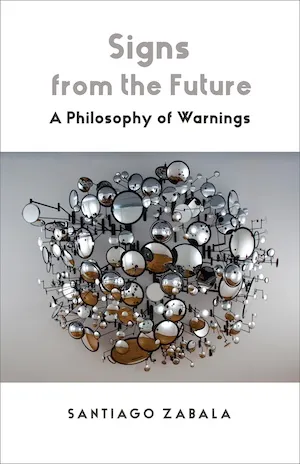
Signs from the Future
Santiago Zabala Signs from the Future: A Philosophy of Warnings Columbia University Press 256 pages, 5.5 x 8.5 inches ISBN: 9780231221726
Available here →December 1, 2025
20251201-zabala-santiago-signs-from-the-future-philosophy-of-warnings-1
In a nutshell
The rest of this thread

Santiago Zabala
Santiago Zabala is a philosopher and cultural critic who grew up in Rome, Vienna, and Geneva. Since 2010, he has been an ICREA Research Professor of Philosophy at Pompeu Fabra University in Barcelona. His books, articles, and research focus on the meaning of art, politics, and freedom in the twenty-first century, when, as he argues, "the greatest emergency has become the absence of emergency." Zabala believes that philosophy's goal is to draw our attention to these missing emergencies (such as climate change or economic inequality) to disrupt the ongoing “return to order” that surveillance capitalism and right-wing populism are forcing upon us.
Pull this thread
Warnings are not predictions, their whole force is the pressure they exert on the present.
Know something the rest of us don't?
Most threads on Rorotoko begin with our invitation. Any thread can begin with a proposal: you write it with the same prompts every thread answers, and we review it.
Propose a thread →