
Santiago Zabala
Signs from the Future
I hope that readers who are simply browsing the book will immediately recognize the difference between “philosophical warnings” and “trigger warnings.” While the latter aims to alert students and viewers to traumatic educational or media content, the former signals the existential consequences of ignoring these alerts. This explains why Greta Thunberg plays such a central role in the book. If she has managed to warn us more effectively than scientists, it’s not just because she humanized the climate crisis like few others—by going on strike and calling out numerous politicians whose inaction endangered our future—but mainly because she has changed our view of scientific warnings. When she questions the cultural belief that adults should teach children, she highlights that “adult knowledge” is no longer enough; it has become outdated and needs replacing. That’s why her call to panic is aimed at “normal” people—those who never skip school and are never forced to face an emergency. If “trigger warnings” protect us from emergencies, “philosophical warnings” draw us into awareness of absent emergencies—that is, warnings. The future will belong to warnings, or it will not exist at all.
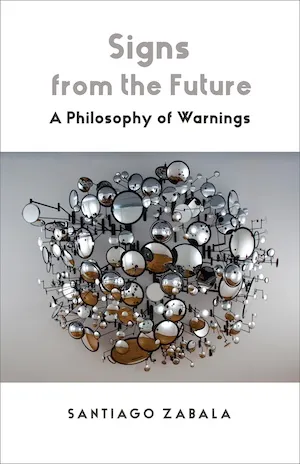
In sum, warnings, contrary to predictions, are not meant to persuade anyone. They are meant to pressure us into changing the present, which is heading in a dangerous direction. That is why I refer to them as signs from the future. However, the future of warnings differs from that of predictions. While predictions require us to submit—there is nothing we can do once we are told the virus has spread—warnings invite us to change that future because the virus will spread unless we act now. That’s why the French word “avenir” fits better to describe the future of warnings. Warnings point to what is to come (“a venir”), an unpredictable event we must be ready to listen to and interpret. The image I chose as the cover for this book is "Compound Eye," a sculpture by American artist Graham Caldwell; it’s a fitting illustration of what warnings are, as well as what makes them. As we approach the sculpture, the horizon seen through the mirrors widens, creating a sense of pressure that calls for a response. The different sizes of the mirrors demand that we interpret what they reflect, since what they reveal is never an objective view of reality. If we imagine a “politics of warnings,” its main concern would not be facts, truths, or the future that make up a warning, but rather the pressure we can exert to change the present. The political nature of warnings calls for practices—from philosophers, filmmakers, and journalists, among others—that are somehow more comprehensive, even if they produce fewer immediate political results.
Curator: Rachel Althof
Signs from the Future
Santiago Zabala Signs from the Future: A Philosophy of Warnings Columbia University Press 256 pages, 5.5 x 8.5 inches ISBN: 9780231221726
Available here →December 1, 2025
20251201-zabala-santiago-signs-from-the-future-philosophy-of-warnings-3
A close-up
The rest of this thread
Santiago Zabala
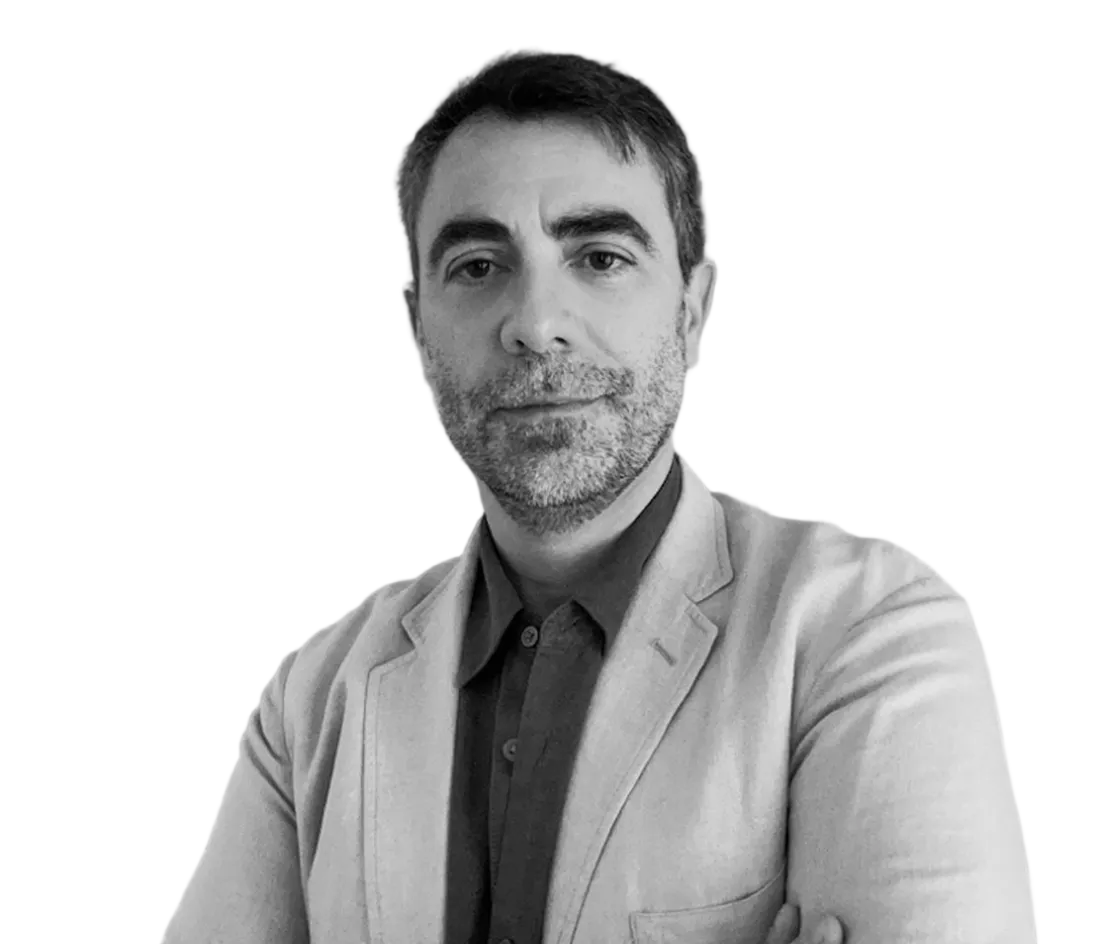
Santiago Zabala is a philosopher and cultural critic who grew up in Rome, Vienna, and Geneva. Since 2010, he has been an ICREA Research Professor of Philosophy at Pompeu Fabra University in Barcelona. His books, articles, and research focus on the meaning of art, politics, and freedom in the twenty-first century, when, as he argues, "the greatest emergency has become the absence of emergency." Zabala believes that philosophy's goal is to draw our attention to these missing emergencies (such as climate change or economic inequality) to disrupt the ongoing “return to order” that surveillance capitalism and right-wing populism are forcing upon us.
Pull this thread
Warnings are not predictions, their whole force is the pressure they exert on the present.
Know something the rest of us don't?
Most threads on Rorotoko begin with our invitation. Any thread can begin with a proposal: you write it with the same prompts every thread answers, and we review it.
Propose a thread →