
Meirav Jones
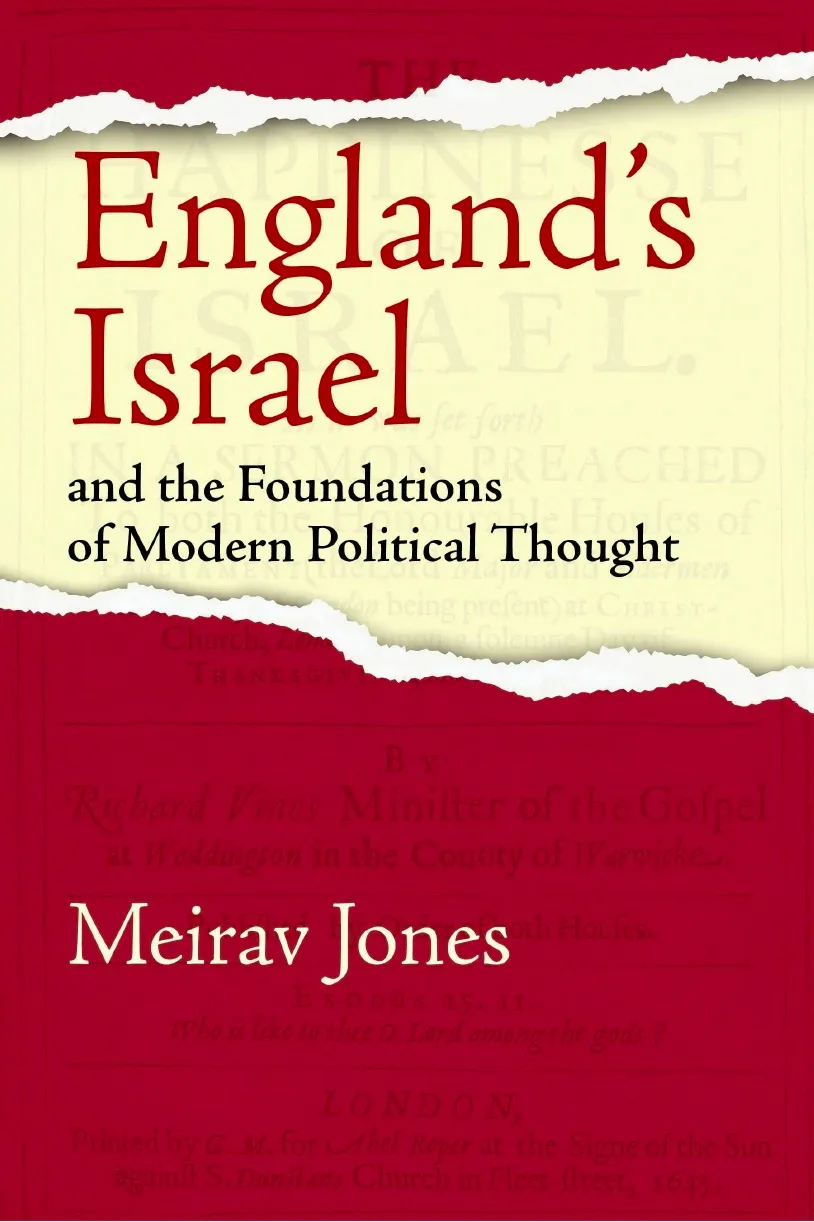
England’s Israel and the Foundations of Modern Political Thought
We tend to think of modernity as a time when religion could be set aside without this having a major effect on public discourse. But this understanding of modernity is actually a remnant of a time, not so long ago, when there was consensus that religion was in decline and had been since the onset of the modern era and that it would ultimately disappear from public life. This consensus held strong at least from the 1960s until the twenty-first century, with 9/11 often cited as a rude awakening. Today – with evangelicals in the white house and religious Catholics, Muslims and Jews setting political agendas worldwide – few would argue that religion is in decline. Yet even if we recognize the place of religion in public life today, most of our textbook studies of key thinkers and ideas of modernity were written from the perspective of that now debunked myth of secularization, and this matters. The narratives we tell about how we got from there to here are narratives of how we moved from religious to secular times; from medieval or dark ages to modernity and enlightenment. In studies of early modern Europe we have compelling accounts of Calvinists as proto-secular revolutionaries, explorations of the millenarian idea of progress as prefiguring the scientific idea of progress, and accounts of seventeenth-century political theorists writing outside of any religious context, constructing ideas and institutions inspired by the revival of classical—Greek and Roman—thought. These works all present paths to secular politics, either through translation from the theological to the political, or through the construction of an entirely non-theological political discourse. They also reify a divide we see today, when secular or liberal thinkers seem to lack any grounds for conversing with religious political actors. In the big picture, then, this book can be read as an intervention. By demonstrating that modern ideas emerged in conversation with theological politics, it presents the possibility that there is a conversation to be had today between theory and theology that could be transformative in terms of the possibilities for political and even just human life. It also supports, from a “history of ideas” perspective, movements that have emerged to counter some of the political damage that interpretations of religion have done and are doing. One example of this is Pope Francis’ work to reinterpret Christianity as supporting environmental stewardship, acknowledging the ecological damage done by the church’s traditional interpretation of the idea of subduing the earth. Another example is The Halachic Left’s work in Israel, interpreting Jewish texts to support Palestinian rights to counter supremacist readings of Jewish texts offered by right-wing religion. Such efforts appear, following the history of political thought presented in this book, as taking part in the same project foundational thinkers of modern politics were engaged in; not rejecting religious texts and images for the harm they cause in public and political discourse, but reinterpreting these same texts and images to do better.
Curator: Rachel Althof
England’s Israel and the Foundations of Modern Political Thought
Meirav Jones England’s Israel and the Foundations of Modern Political Thought University of Pennsylvania Press 248 pages, 6 x 9 inches, ISBN: 978-1512827804
Available here →January 3, 2026
20260103-jones-meirav-englands-israel-and-the-foundations-of-modern-political-thought-2
The wide angle
The rest of this thread
.webp)
picture by Tamar Abadi
Meirav Jones
Meirav Jones is a visiting scholar at the Anne Tannenbaum Center for Jewish Studies at the University of Toronto. She received her PhD in Political Science from the Hebrew University of Jerusalem in 2013 and has since held teaching and research positions at McMaster University, Tel Aviv University, the Hebrew University of Jerusalem, Yale University, and the University of Pennsylvania. She is the author of numerous articles in political science, religious studies, the history of political thought, Israel Studies, and International Relations theory. England’s Israel and the Foundations of Modern Political Thought is her first monograph.
Pull this thread
Know something the rest of us don't?
Most threads on Rorotoko begin with our invitation. Any thread can begin with a proposal: you write it with the same prompts every thread answers, and we review it.
Propose a thread →