
Meirav Jones
England’s Israel and the Foundations of Modern Political Thought
England’s Israel and the Foundations of Modern Political Thought explores how foundational ideas of modern politics that are usually considered secular were, in fact, born out of deep conversations and negotiations with religion.
To unpack a little, mid-seventeenth century England was a hotbed in which some of the most important ideas of modern politics were conceived: Thomas Hobbes conceived of his social contract, John Selden wrote major legal treatises which were foundational for modern natural and international law, and England participated – in theory and in practice – in the wave of republicanism that swept over Europe. This was also the period of the English Civil War, which has been portrayed by historians as a “war of religion” and a “revolution of saints,” characterized by religious ends and motivations guiding politics.
The book demonstrates that the political theory published in the period was significantly related to the religiously motivated politics of the time through the Hebraic language and imagery that was shared by theorists and saints. In the twenty-year period of 1640-1660, when Hobbes, Selden, and their contemporaries were active, over 40 percent of all texts published in England contained one or more of the terms “Hebrew,” “Israel,” “Jerusalem,” “Zion,” or “Jew.” Further, all known works of political theory from the period employ this language and imagery. When Presbyterian and Church of England ministers, including preachers in parliament, addressed England as “Israel,” the English were to see themselves as God’s chosen people, and there was a sense of urgency or apocalyptic expectation expressed in the language. When foundational theorists of the modern state used the same language, they explicitly rejected the destabilizing identity of England as Israel. They turned English readers, who were intimately familiar with the biblical narrative and the Old Testament people, towards the exemplary structures of Israelite laws and institutions, that in their interpretations were both more conducive to stability and more pleasing to God than the structures of Greece or Rome.
Ultimately, the book argues that it was through a sweeping revival of Hebrew in Europe in the sixteenth and seventeenth centuries, that the foundations of modern politics were laid in conversation with Hebraic thought and action and in negotiation with Jewish ideas and ideas of the Jews as understood by Christian thinkers and actors. Modern politics did not develop from within a conversation among elites, and was not conceived as a Godless enterprise, even by its most renown secular architects. Modern – even secular – state politics did not only speak the language of religious politics but was conceived in its terms. As such, modern politics does not only have the tools to speak to religion but can do so in its native tongue. Understanding this has implications for how liberal and modern ideas can exist in conversation with religious and even apocalyptic political thought and action in our time.
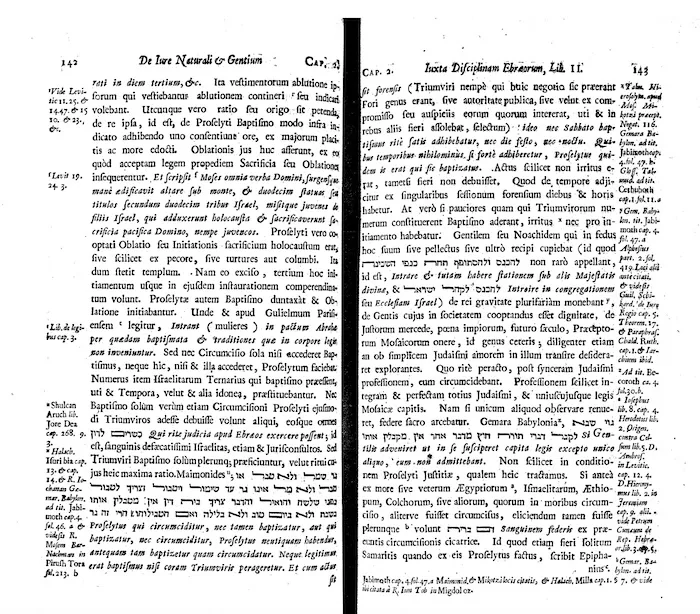
page of Selden's De Jure
Curator: Rachel Althof
.webp)
England’s Israel and the Foundations of Modern Political Thought
Meirav Jones (2025). England’s Israel and the Foundations of Modern Political Thought University of Pennsylvania Press 248 pages, 6 x 9 inches, ISBN: 978-1512827804
Available here →January 3, 2026
20260103-jones-meirav-on-england-israel-modern-thought
In a nutshell
The rest of this thread
.webp)
Photo by Tamar Abadi
Meirav Jones
Meirav Jones is a visiting scholar at the Anne Tannenbaum Center for Jewish Studies at the University of Toronto. She earned her PhD in Political Science from the Hebrew University of Jerusalem in 2013 and has held teaching and research appointments at McMaster University, Tel Aviv University, the Hebrew University of Jerusalem, Yale University, and the University of Pennsylvania. Her work spans political science, religious studies, political thought, Israel Studies, and international relations. England’s Israel and the Foundations of Modern Political Thought is her first monograph.
Pull this thread
Modern secular politics was conceived inside mid-seventeenth-century England's theological fight.
Know something the rest of us don't?
Most threads on Rorotoko begin with our invitation. Any thread can begin with a proposal: you write it with the same prompts every thread answers, and we review it.
Propose a thread →