
Meirav Jones
England’s Israel and the Foundations of Modern Political Thought
Pages 53-54 frame Thomas Hobbes’ Leviathan, usually read as a work of secular political thought, as an intervention in the theological-political of his time:Hobbes was explicit, in his autobiography, about the extent to which his publication priorities were set not by academic or “republic of letters” considerations but by his concern about what was being done with, and attributed to, God’s word in England: “Although this was the moment at which I had resolved to write my book De corpore, the materials for which were completely ready, I was forced to postpone it because I could not tolerate so many atrocious crimes being attributed to the commands of God, and decided that my highest priority was to absolve the divine laws.” How Hobbes responded to the “atrocious crimes” he found being attributed to the commands of God was to conduct his own inquiry into the commands of God and their place in politics, through the sources of his opponents. Hobbes turned to scripture, but his reading was so unconventional that in the dedication of Leviathan he anticipated that of all the controversy Leviathan would conjure up, his reading of scripture would be the most controversial aspect of the work.Hobbes’ participation in the theological-political context of seventeenth century England by taking the terms of his opponents and redefining them for his own purposes resembled his mode of participation in other contemporary conversations. On page 55I offer an amusing take on this:John Wallis, in a sympathetic letter to Robert Boyle sent in response to his hearing that Boyle had been challenged by Hobbes about his claim to have created a vacuum [wrote]: “Mr. Hobs is very dexterous in confuting others by putting a new sense on their words rehearsed by himself: different from what the words signifie with other Men. And therefore if you [Boyle] shall have occasion to speak of chalk, he’ll tell you that by chalk he means cheese: and then if he can prove that what you say of chalk is not true of cheese, he reckons himself to have gotten a great victory.” Among the terms Hobbes redefined when he participated in the theological-political discourse of his time, was “Israel” which he defines as a historic people “in the wilderness,” and not the Church or the English, and the “kingdom of God,” which he removes from the present or future and places in the past. Hobbes’ definitions draw his readers to read the Bible as an ancient model that offers stable and long-lasting political frameworks, on a par with Greece and Rome, rather than a prophetic text breeding instability. This was such a powerful move that republican theorists who despised Hobbes’ politics shared—and some consciously adopted—his approach when it came to responding to theological politics that they saw as no less threatening than Hobbes did. The way seventeenth-century political theorists worked together to counter “new Israel” politics by redefining its terms made space for the thriving of ideas we consider secular today.England’s Israel was not unique in the early modern world, with the Dutch and other European nations also seeing themselves as “Israel,” or God’s chosen, and with political theorists conceiving lasting political and legal structures grounded in the language, sources, and images of the Godly in the political. We are used to thinking of Hobbes and his contemporaries as thinkers through whom politics became secular, but there is no indication that they themselves intended to end the conversation with religion, and quite the contrary. The political structures proposed in Leviathan, for example, presume a society in which the Bible is canonical. While religion may be set in a separate, non-political realm, this is justified through the tenets and sources of Christianity that is engaged, and its centrality to the lives of believers is acknowledged. This book, then, is an important corrective to the history of ideas for reasons that anyone concerned with the fate of modern politics should find compelling. First, it allows us to better understand the foundations of contemporary laws and institutions such as rule of law and modern sovereignty, and the extent to which they were conceived in a manner far less detached from messy politics than we may otherwise have presumed. Second, it reveals a mode of conversation that was crucial at the dawn of modernity and that modern theorists considered crucial in an ongoing manner, between religious political actors for whom politics is a vehicle to higher ends, and those concerned with stability and the preservation of life in this world. Third, this mode of conversation may not only be relevant to understanding the past, but it may open possibilities for effective political theory in the present. Just as acknowledging the centrality of religion to so many and finding value in the sources, language, and imagery of religious political actors was key to founding modern politics, so too in our time, acknowledging and finding value in that which fellow citizens find sacred could be key to moving productively past deep social and political divides.
Curator: Rachel Althof
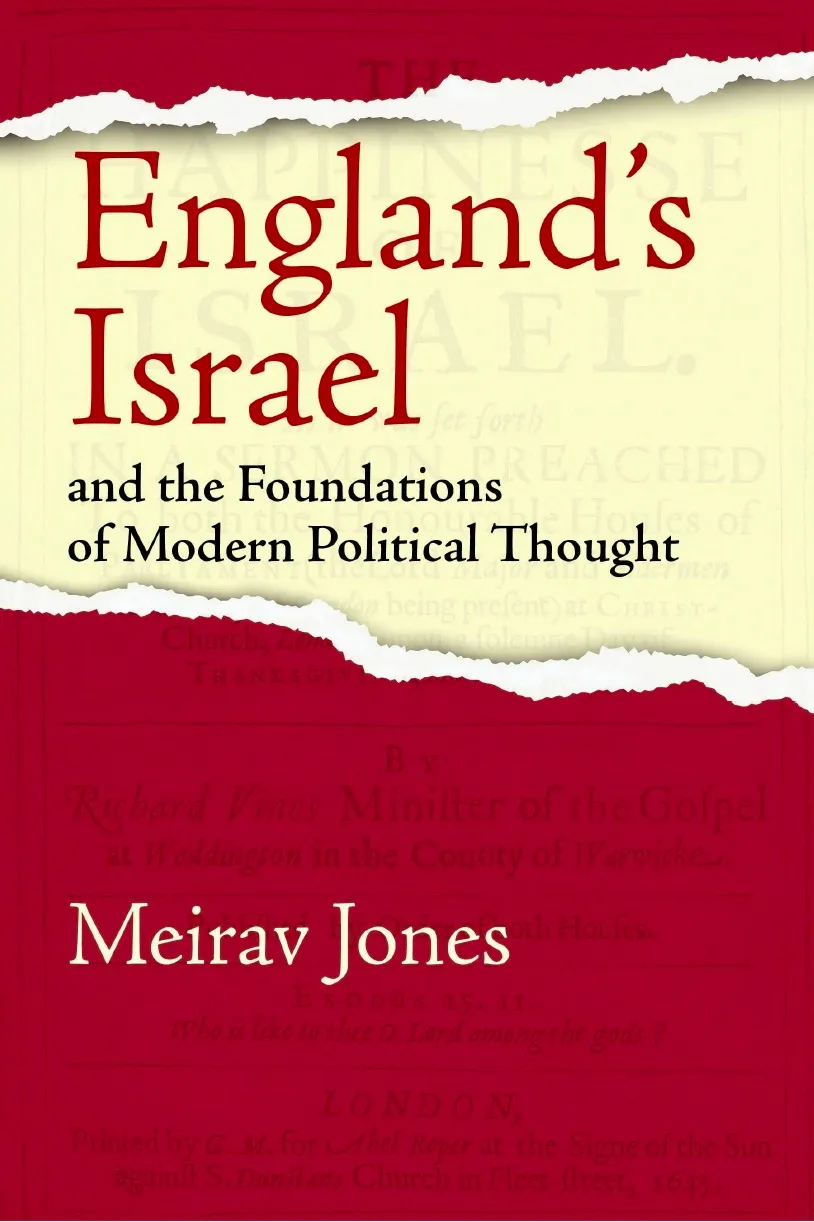
England’s Israel and the Foundations of Modern Political Thought
Meirav Jones England’s Israel and the Foundations of Modern Political Thought University of Pennsylvania Press 248 pages, 6 x 9 inches, ISBN: 978-1512827804
Available here →January 3, 2026
20260103-jones-meirav-englands-israel-and-the-foundations-of-modern-political-thought-3
A close-up
The rest of this thread
.webp)
picture by Tamar Abadi
Meirav Jones
Meirav Jones is a visiting scholar at the Anne Tannenbaum Center for Jewish Studies at the University of Toronto. She received her PhD in Political Science from the Hebrew University of Jerusalem in 2013 and has since held teaching and research positions at McMaster University, Tel Aviv University, the Hebrew University of Jerusalem, Yale University, and the University of Pennsylvania. She is the author of numerous articles in political science, religious studies, the history of political thought, Israel Studies, and International Relations theory. England’s Israel and the Foundations of Modern Political Thought is her first monograph.
Pull this thread
Hobbes and his contemporaries founded modern politics by redefining the Bible's political terms.
Know something the rest of us don't?
Most threads on Rorotoko begin with our invitation. Any thread can begin with a proposal: you write it with the same prompts every thread answers, and we review it.
Propose a thread →