
Lilia Topouzova
Unsilencing
Unsilencing is the first comprehensive study of the Bulgarian gulag— a network of forced-labor camps and prisons that operated throughout the communist era from 1945 to 1989. Referred to as “Little Siberia,” these camps interned thousands without trial, subjected them to inhumane conditions, and silenced them for decades. Drawing on two decades of archival research, oral history interviews with survivors and perpetrators, and an array of declassified state documents, I reconstruct the harrowing reality of life behind barbed wire. The book explores how the communist regime systematically used these camps to suppress dissent, target minority groups, and instill fear across the population.
Unsilencing also examines the post-1989 period showing how Bulgaria has grappled with its recent past: the brief life of its truth commission, the aborted trials of former officials and guards, and the ongoing struggle over collective memory. Telling the little-known story of the Bulgarian gulag and its aftermath makes possible a close study that asks difficult questions about the origins of state violence and how we come to terms with it. How do we address the trauma of the camps, which still lingers in everyday life? Who do we hold accountable for crimes committed in the camps? What does it mean to survive a camp? To remember it? Who decides which memories matter? How are families and communities impacted by the legacy of violence?
To anchor these complex questions, multiple individual human threads run through the book, the life stories of ordinary people caught in the maelstrom of political ideologies and sweeping historical transformation. Some of these ordinary people rose to power, while others were destroyed by it. The storytelling texture makes the book readable and resonant beyond its immediate geography and historical period.
Having worked for over twenty years on this topic and in multiple capacities––as a scholar, writer, filmmaker, and artist—I wanted to take readers with me on the circuitous yet meaningful path of uncovering a history meant to vanish.
It is why I begin the history of the gulag with its attempted erasure. In 1990, shortly after the fall of the communist regime, the Minister of the Interior ordered the destruction of the secret-police archives. To reconstruct this history, one must begin from absence—from what was purged, burned, or buried. At first, I treated silence as an obstacle to be overcome, but with time I learned to work with it, to weave it into the narrative itself. I began to look for evidence where it was least expected: in discarded papers, in abandoned camp sites, and in the pauses and hesitations of survivors whose words faltered under the weight of unspeakable experiences.
The book invites the reader with me as I piece together purged archives, fragmented testimonies, and the lived aftermath of fear. It argues that silence is not merely the absence of speech or memory but a historical agent in its own right—one that shapes what can be known, said, and imagined.
.webp)
The author collecting files and folder in front of a dumpster in Sofia. June 2022. Photo courtesy of Krasimira Butseva.
Curator: Rachel Althof
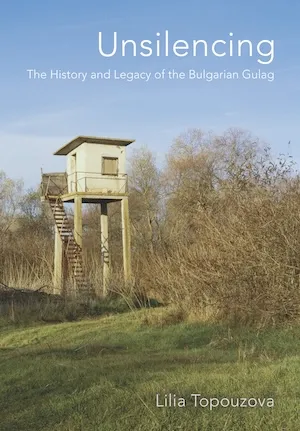
Unsilencing
Lilia Topouzova (2025). Unsilencing: The History and Legacy of the Bulgarian Gulag, Cornell University Press, 318 pages, ISBN: 978-1501782022
Available here →January 7, 2026
20260107-lilia-topouzova-unsilencing-legacy-bulgarian-gulag
In a nutshell
The rest of this thread

Lilia Topouzova
Lilia Topouzova is Associate Professor of History and Creative Nonfiction at the University of Toronto. Her research and creative practice focus on memory, trauma, and the legacies of authoritarianism. She is the author of Unsilencing: The History and Legacy of the Bulgarian Gulag (Cornell University Press, 2025) and co-creator of The Neighbours, Bulgaria’s acclaimed pavilion at the 2024 Venice Biennale.
Pull this thread
Silence is not the absence of speech or memory but a historical agent and a political technology in its own right.
Know something the rest of us don't?
Most threads on Rorotoko begin with our invitation. Any thread can begin with a proposal: you write it with the same prompts every thread answers, and we review it.
Propose a thread →