
Lilia Topouzova
Unsilencing
Unsilencing belongs to the global conversation about how societies remember—or refuse to remember—state violence. It speaks to the legacy of the gulag but also to the aftermath of authoritarianism everywhere, from past dictatorships to the lives of today’s refugees and political prisoners. The book is also a meditation on silence itself—how it becomes a political technology that extends beyond repression into everyday life, persisting long after the collapse of authoritarian regimes.
During my research, I encountered a tangible sense of despair and fragility. Few were left unscarred by the system of political detention and the impunity with which the secret police operated. Pain, fear, guilt, and anguish endure in victims, in perpetrators, and in society at large. I thought often about how to make members of this society care—people who had not been directly affected by violence but who nonetheless lived with its consequences, often without realizing it. This is, of course, a broader philosophical question: why should any of us care about past violence that no longer intrudes upon our daily lives? There is no single or absolute answer, yet when people are invited to reflect on their personal histories, a connection to this difficult past frequently emerges. The same holds true for me.
I was born in Communist Bulgaria, and I was a proud member of the Communist Youth League when the regime collapsed in 1989. One moment I was wearing a red scarf and saluting Soviet revolutionary heroes; the next I watched the hammer and sickle removed from Party headquarters and joined crowds celebrating the demise of the regime, eager for a democratic future that seemed just around the corner. I left Bulgaria in the early 1990s and grew up in Montreal.
As a graduate student, I came across a photograph of a female camp guard on trial for crimes committed in the gulag. Her expression was at once ordinary and unfathomable. That image drew me back to Bulgaria—to the archives, to the barren camp landscapes, and to the closed world of survivors. For the next two decades, I navigated between scholarship and creative practice, each offering a distinct way of understanding the recent past.
I co-created the documentary The Mosquito Problem & Other Stories (2007) and the multimedia installation The Neighbours (2022–2024). Unlike the solitude of archival research and writing, both were collective projects, born of an impulse to translate silence into form. In collaborating with Julian Chehirian and Krasimira Butseva—and bringing The Neighbours to the 2024 Venice Biennale—we sought to reckon with collective trauma and to affirm that remembering is an intergenerational endeavor.
My book weaves these experiences into a written practice that treats history as encounter—between researcher and witness, document and silence. Each interview and each archival fragment became a point of entry into larger questions: how does one listen to lives lived under fear, and how might those lives alter our understanding of what history is?
.webp)
The author collecting files and folder in front of a dumpster in Sofia. June 2022. Photo courtesy of Krasimira Butseva.
Curator: Rachel Althof
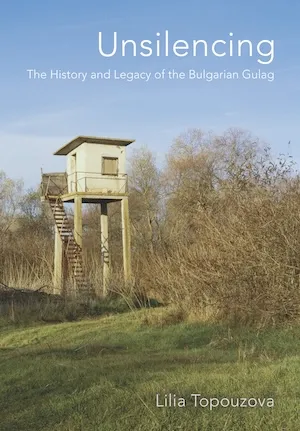
Unsilencing
Lilia Topouzova (2025). Unsilencing: The History and Legacy of the Bulgarian Gulag, Cornell University Press, 318 pages, ISBN: 978-1501782022
Available here →January 16, 2026
20260124-lilia-topouzova-unsilencing-legacy-bulgarian-gulag
The wide angle
The rest of this thread

Lilia Topouzova
Lilia Topouzova is Associate Professor of History and Creative Nonfiction at the University of Toronto. Her research and creative practice focus on memory, trauma, and the legacies of authoritarianism. She is the author of Unsilencing: The History and Legacy of the Bulgarian Gulag (Cornell University Press, 2025) and co-creator of The Neighbours, Bulgaria’s acclaimed pavilion at the 2024 Venice Biennale.
Pull this thread
Silence is a political technology in its own right, and it outlives the regime that installed it.
Know something the rest of us don't?
Most threads on Rorotoko begin with our invitation. Any thread can begin with a proposal: you write it with the same prompts every thread answers, and we review it.
Propose a thread →