
Lilia Topouzova
Unsilencing
I would begin with the preface where I describe my first meeting with Krum Horozov, one of the most candid survivors I interviewed. In the late spring of 2006, I stood at the door of his apartment not yet knowing that this encounter would define the years to come. Horozov, an eighty-one-year-old former political prisoner, had spent eleven years in camps and prisons, many of them in Belene, the most infamous of Bulgaria’s forced-labor camps.
Over the course of several hours, this soft-spoken but determined man narrated his story: his imprisonment as a member of the agrarian left, his survival of Belene’s brutal regime, and his relentless efforts after 1989 to make the memory of the gulag public. Although he had served in the Grand National Assembly, helping draft Bulgaria’s new democratic constitution, his later work met indifference. His memoirs and an extraordinary album of camp drawings and architectural blueprints lay stacked in his living room—self-published, unsold, unseen. For every story he told, he produced a document from his declassified file or pointed to a sketch in the album. “So that you don’t doubt me,” he whispered, leaning toward the recorder. Perhaps he mistook my disbelief for doubt; or perhaps he was simply used to being doubted.
When our interview ended, Horozov walked me to the door. Dressed neatly in an old brown suit, he handed me copies of his memoir and album but refused to take any payment. We lingered across the threshold in silence, the door half-open between us. Then, quietly, he said, “Our voices will not suffice—there need to be others.” He closed the door, and I stood listening to the faint click of the lock.
That sentence has stayed with me ever since. It captures the essence of Unsilencing: remembrance as an intergenerational relay, testimony as a collective endeavor. Horozov’s words transformed my understanding of what it means to write history. They suggested that bearing witness is never finished—that it depends on others to continue it.
The book traces not only the history of Bulgaria’s forced-labor camps but also the culture of silence that outlived them—how fear, denial, and forgetting seeped into everyday life and shaped the country’s post-socialist transition. Silence, I suggest, is not merely the absence of speech but a political force, one that determines what can be known and what remains hidden.
The implications extend far beyond Bulgaria. Across the world, state violence is minimized, archives are manipulated, and citizens are urged to forget in the name of unity. Unsilencing speaks to these broader patterns: the fragility of truth in the aftermath of repression and the unfinished nature of justice. It reveals that transitional justice cannot succeed without an active culture of remembrance. Remembering becomes a civic responsibility, a collective act of care that resists indifference. In that sense, the book is not only about the Bulgarian gulag—it is about us, and about how we choose to confront, or to look away from, the violence that still shapes our world.
At its core, Unsilencing asks what it means to live after violence—how trauma persists across generations and how memory, if neglected, curdles into cynicism. The survivors I met taught me that remembrance is a form of resistance. Their testimonies reveal that silence can never fully contain what it seeks to erase; it lingers in families, in the landscape, and in the archives that were meant to destroy it.
This is also where art and collaboration enter the conversation. My work with the artist-scholars Krasimira Butseva and Julian Chehirian on The Neighbours grew directly out of the oral histories at the heart of the book. Over a decade, we transformed research into a multimedia installation that reimagined the homes of survivors of the Bulgarian gulag.
Presented as Bulgaria’s national pavilion at the 60th Venice Biennale (2024), The Neighbours recreated a darkened apartment from the early post-socialist years. Three rooms—living room, bedroom, and kitchen—evoked different modes of remembering through video projections, ambient sound, and artefacts from former camp sites. Visitors never saw the survivors; they heard only their voices.
Critics named The Neighbours one of the Biennale’s “must-see” installations. It drew nearly 60,000 visitors and received international media coverage. Its impact lay not only in visibility but in intimacy: audiences described feeling “inside memory,” compelled to listen differently. We collected four notebooks filled with comments. Hundreds of pages in languages we could and could not read from people around the world who said that the stories, sighs, and whispers could have been those of their own grandparents or neighbours. Something so distant felt suddenly close.
In Venice, research became a public act of collective remembrance, realized through collaboration between survivors, artists, and scholars. When scholarship enters conversation with art, it creates spaces of empathy that bridge disciplines, generations, and nations. Unsilencing, then, is not a single act or scholarly method but an ongoing practice—a way of insisting that even the most troubling histories remain audible.
.webp)
The author collecting files and folder in front of a dumpster in Sofia. June 2022. Photo courtesy of Krasimira Butseva.
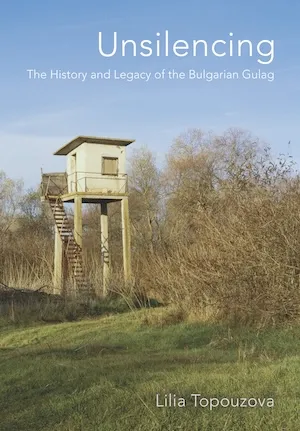
Unsilencing
Lilia Topouzova (2025). Unsilencing: The History and Legacy of the Bulgarian Gulag, Cornell University Press, 318 pages, ISBN: 978-1501782022
Available here →January 17, 2026
20260324-lilia-topouzova-unsilencing-legacy-bulgarian-gulag
A close-up
The rest of this thread

Lilia Topouzova
Lilia Topouzova is Associate Professor of History and Creative Nonfiction at the University of Toronto. Her research and creative practice focus on memory, trauma, and the legacies of authoritarianism. She is the author of Unsilencing: The History and Legacy of the Bulgarian Gulag (Cornell University Press, 2025) and co-creator of The Neighbours, Bulgaria’s acclaimed pavilion at the 2024 Venice Biennale.
Pull this thread
Silence is a political technology in its own right, and it outlives the regime that installed it.
Know something the rest of us don't?
Most threads on Rorotoko begin with our invitation. Any thread can begin with a proposal: you write it with the same prompts every thread answers, and we review it.
Propose a thread →