
Shaj Mathew
The Dialectic of Cosmopolitan Time
The book asks not where the Global South is—a fair question in its own right—but when it is.
After the colonial era, many postcolonial writers felt an acute sense of belatedness. They considered the “true present” to be somewhere else—namely, in Europe. If these writers felt behind the times, postcolonial theorists responded to their supposed time lag with a simple theoretical gesture: they asserted that their nations experienced the same “now” as Europe did. They advocated for equality in terms of time.
In the wake of decolonial turn, however, some theorists began to question the desire for temporal parity. Why should postcolonial nations even want to share the same “now” as their former colonial oppressors? This line of thought produced one enduring consequence: a fetish of the precolonial past and a return to “tradition.” These traditions, real or “invented” as Eric Hobsbawm once put it, would excavate indigenous values, languages, and concepts; they would also avoid standardizing European time as universal. Today, returns to tradition are very much in the zeitgeist—on the left and the right, in both the Global North and the Global South. Tradition manifests itself in the concept of indigeneity on the left, while it surfaces in right-wing nostalgia for authentic cultural values. Both retreats into the past are products of the present. Returns to tradition, what’s more, almost always lead to nativism and nationalism. That’s why this book seeks to reinvigorate the term cosmopolitanism instead.
A cosmopolitan sense of time, I suggest, avoids the siren song of tradition, as well as the earlier desire to simply assimilate into European time. In this way, cosmopolitanism’s tagline—coexistence—gets a new dimension. Instead of the coexistence of religions, cultures, or languages, we get the coexistence of contradictory times. Religious and secular, revolutionary and reactionary, linear and non-linear—these discrepant forms of temporality give each other meaning.
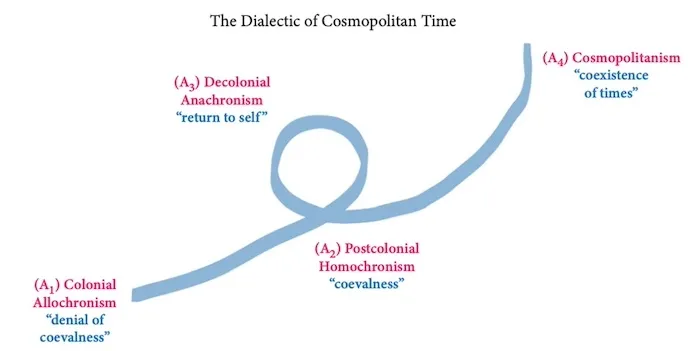
The four stages of the dialectic
Curator: Rachel Althof

The Dialectic of Cosmopolitan Time
Shaj Mathew The Dialectic of Cosmopolitan Time Oxford University Press, 200 pages, 6 x 9 inches, ISBN: 9780197819074
Available here →January 19, 2026
20260119-mathew-shaj-on-dialectic-cosmopolitan-time-1
In a nutshell
The rest of this thread

Shaj Mathew
Shaj Mathew is a theorist of global modernism and modernity. His scholarship looks to modern and contemporary Persian and Turkish literature, with a special interest in the antiquity of these expressions of modernity. His second book project studies the influence of ancient Indian philosophy on global modernist literature. Excerpts of these book projects, in addition to translations and articles, appear in PMLA, MLQ, Modernism/modernity, Philosophy and Literature, the ACLA State of the Discipline Report, and New Literary History, the latter of which awarded him the 2020 Ralph Cohen Prize. He occasionally contributes to The Nation, The New York Times, and The New Yorker.
Pull this thread
Time is also cultural, political, and shaped by power.
Know something the rest of us don't?
Most threads on Rorotoko begin with our invitation. Any thread can begin with a proposal: you write it with the same prompts every thread answers, and we review it.
Propose a thread →