
Shaj Mathew
The Dialectic of Cosmopolitan Time
The first two words of the book are Edward Said. His body of work continues to inspire debate within postcolonial studies almost 50 years after the publication of his 1978 hit, Orientalism. I’m less interested in that specific text than in the misunderstandings or scholarly lacunae it generated. (A focus on Orientalism also obscures his incredible range, which included classical music.) Thinkers such as Hamid Dabashi, Dipesh Chakrabarty, Vivek Chibber, and Wael Hallaq have helped me think through Said’s critical afterlife.
Beyond postcolonial studies, the book taps into the amazingly rich scholarship on “time” across cultures: I’m thinking of On Barak’s On Time; Vanessa Ogle’s The Global Transformation of Time; Avner Wishnitzer’s Reading Clocks, Alla Turca; Mark Rifkin’s Beyond Settler Time; and a modernist classic, Henri Bergson’s Time and Free Will.
More pertinent to the book’s argument, however, is Johannes Fabian’s Time and the Other. Fabian advances Said’s more geographic argument about the Orient and Occident in terms of time. For Fabian, anthropology locates its (initially non-European) object of study in a more primitive time. He deems the temporal predicament of non-European cultures “allochronism”—the Greek “allo” denotes their supposedly “other,” belated, or backward location in time. The dialectic of my book’s title points to a journey in which theorists of the postcolonial or non-European world try to find a way out of allochronism, or this supposedly more primitive stage of history. Postcolonial theorists first opted for homochronism, arguing that all cultures occupy the same slice of time, while decolonial theorists subsequently elected for anachronism, a term which evokes the (literally) backward-looking fantasies of the past that surface today and dictate our political landscape. Unconvinced by the solutions of homochronism and anachronism, my book culminates in a defense of cosmopolitanism. This word already has a meaning—world citizenship—but the book reimagines its tagline: coexistence. The coexistence it imagines is one of temporality.
The project of temporal coexistence sheds light on the spirit of our own times. In the present conjuncture, invented traditions proliferate day by day. The book models a way for these discrepant tempos—antiquity and modernity, universal and local time, qualitative and quantitative—to coexist.
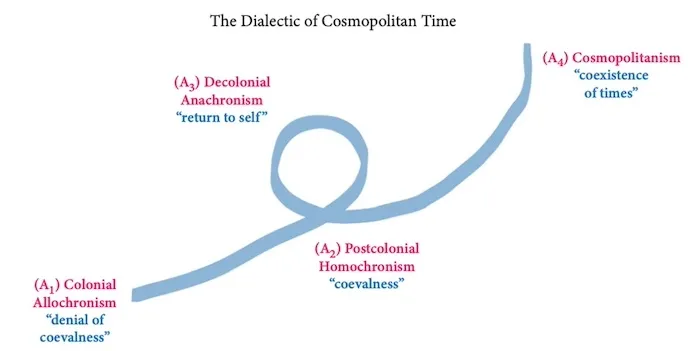
The four stages of the dialectic
Curator: Rachel Althof

The Dialectic of Cosmopolitan Time
Mathew, Shaj The Dialectic of Cosmopolitan Time Oxford University Press, 200 pages, 6 x 9 inches, ISBN: 9780197819074
Available here →January 19, 2026
20260119-mathew-shaj-on-dialectic-cosmopolitan-time-2
The wide angle
The rest of this thread
Shaj Mathew
Shaj Mathew is a theorist of global modernism and modernity. His scholarship looks to modern and contemporary Persian and Turkish literature, with a special interest in the antiquity of these expressions of modernity. His second book project studies the influence of ancient Indian philosophy on global modernist literature. Excerpts of these book projects, in addition to translations and articles, appear in PMLA, MLQ, Modernism/modernity, Philosophy and Literature, the ACLA State of the Discipline Report, and New Literary History, the latter of which awarded him the 2020 Ralph Cohen Prize. He occasionally contributes to The Nation, The New York Times, and The New Yorker.
Pull this thread
The question to ask of the Global South is when it is, and only cosmopolitanism survives as an answer.
Know something the rest of us don't?
Most threads on Rorotoko begin with our invitation. Any thread can begin with a proposal: you write it with the same prompts every thread answers, and we review it.
Propose a thread →