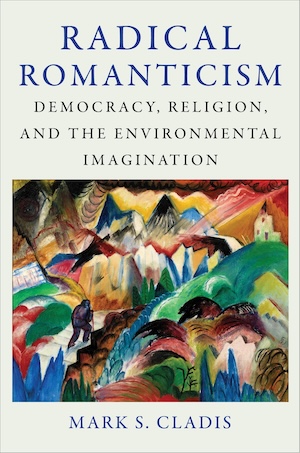
So, you’re at the bookstore. You come upon Radical Romanticism and, flipping through its opening pages, you read a passage on a dream in Wordsworth’s Prelude. A man awakens in a desert, is handed a shell shaped like a book, and hears within it “a loud prophetic blast of harmony… foretelling destruction.” What kind of book is a shell? What kind of warning does it carry? Could its sound be the voice of rising seas, or the earth itself straining to be heard?
In many ways, this book asks how we might learn to listen—how radical Romantic aesthetics can approximate the sound of that shell-book, issuing warnings but also hope, witnessing devastation but also beauty. The writers I study invite readers into an alliance between author, world, and reader, where something in us might awaken and respond with precision, grief, and care. If a browsing reader heard even a faint echo of that shell, I would be grateful.
Next, you flip toward the end of the book and come upon a passage under the heading “A World in Ruins and the Work of Renovation.” There, I try to name something of our shared condition—our ruins, yes, but also the stubborn, shimmering traces of beauty and care that keep us from collapsing into despair. You read: Some ruins are so catastrophic, it is not much of an exaggeration to speak of a ruined world. A “ruined world” need not refer to the entire planet, but to a portion of the planet’s species and entities for whom the world—their world—is ruined.” I describe how certain communities have endured these ruined worlds again and again: enslaved people in the fields, Black residents stranded during Hurricane Katrina, the inhabitants of the Marshall Islands displaced first by nuclear violence and then by rising seas.
But then you read: Wordsworth, Du Bois, and Silko are among the prophetic artists who seek to alert us to the ruins so that we might attend to them. Yet they would also teach us that ruins are not the entire landscape. The passage doesn’t stay with devastation alone. Radical Romanticism insists that beauty, love, and the sacred—however tenuous—still break through. These moments don’t erase oppression; they expose it by contrast and sustain the possibility of renovation. The radical Romantics name the mingling of hope and despair, love and grief, not merely to comfort us but to train our moral attunement.
I would want a browsing reader to land on that passage because it captures something central to the book. We are living through difficult times, and a measure of despair is warranted. It suggests that we are paying attention. But despair is not the whole story. And if we want to navigate these times with any integrity, we have to get the stories right. My students often live inside this tension: grieving what is breaking while fiercely imagining what might yet be healed. That mingling—of brokenness and renovation—is where our humanity needs to stand.
When I think about the implications of Radical Romanticism, I keep circling back to a simple, urgent truth: the crises that first gave rise to Romanticism—inequality, imperialism, environmental devastation—are still very much with us. What the radical Romantics understood is that ecological and political injustices travel together; they grow from the same structures of domination and patterns of estrangement.
So the book tries to show how their thought—their art—can help us. They offer critique, of course—critique of the forces that separate us from one another and from the living world, forces that bring domination and suffering. But they also offer vision: a sense that the moral and aesthetic imagination itself is a political resource, a tool for witness, repair, and living with accountability even when the world feels perilously close to the edge. That imaginative, aesthetic power helps us stay awake to what’s breaking and to what might be mended.
I also hope that Radical Romanticism sparks a renewed confidence in the humanities as sources of ethical imagination and social engagement—especially in a moment when ecological and democratic futures feel uncertain. I want readers to come away with a sense that literature, poetry, philosophy, and spiritual reflection are not luxuries; rather, they are tools for perceiving the deeper contours of our relationships and responsibilities—to fellow humans and to the more-than-human.
If the book has a wish, it is this: that radical Romanticism is understood as a living, ethical conversation, not a museum piece; and that readers recognize themselves as participants in this world-making conversation. Not as isolated agents but as beings enmeshed in woven forms of land, history, community, and care. I want the book to be an invitation into a conversation that insists that beauty and justice, art and ecology, religion and democracy, all take part in the work of imagining how to live together with greater justice and care. Invitations need to be welcoming, and so I tried to write plainly—not to simplify, but to honor what I take to be democratic discourse: a way of speaking that opens doors rather than builds walls, that clears pathways instead of obscuring them with specialized jargon. The book is about ethical responsiveness, about listening across difference, about honoring stories that aren’t our own. Those commitments call for a tone that is candid and welcoming, a voice that stays accountable to the communities and landscapes it touches. My hope is that the style of the book becomes part of the argument.
Ultimately, if a reader closes the book feeling stirred—just a little—to attend more closely to how they live with others, human and more-than-human, and if they feel invited into a more imaginative, just, and ecological practice of democracy, that would bring me real joy.