
Edward Scheinerman
A Guide to Infinity
This tour of mathematical infinities was inspired by my granddaughter Shlomit who, some years ago, called me to ask: What is the number before infinity? A fantastic question! This book is an answer to that question and much more.
This is not a book about mathematics. This is a mathematics book. That is, we engage precisely into how the mathematics of infinity works. By analogy, we don’t just admire that shiny sports car in the show room; we get in and go for a drive.
It is my objective to make all these ideas accessible to as wide of an audience as possible. Readers who remember their high school mathematics are ready to engage the infinite. No calculus required, but we do use algebra and geometry.
Each chapter presents a different way in which infinity is used by mathematicians. For example, we explore two different notions of a line at infinity. One way is an extension of the ordinary plane; this idea was used by artists to make realistic paintings of three-dimensional scenes. Another line at infinity is associated with the more exotic hyperbolic plane (we explain exactly what that is!); this idea arises again in art most notably in the work of M.C. Escher.
The ten different mathematical journeys are best enjoyed in the order presented, but it is perfectly reasonable to read the chapters in a different sequence.
Curator: Rachel Althof
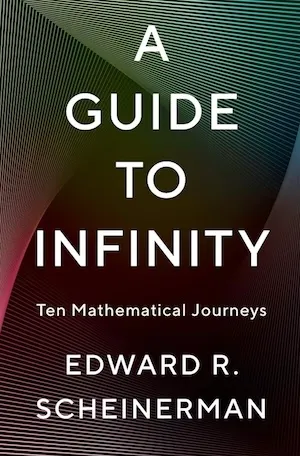
A Guide to Infinity
Edward R. Scheinerman, A Guide to Infinity: Ten Mathematical Journeys, Yale University Press, 192 pages, 6 x 9 inches, 70 b-w illustrations, ISBN: 9780300284799
Available here →February 4, 2026
20260204-scheinerman-edward-guide-to-infinity
The wide angle
The rest of this thread

Edward Scheinerman
Ed Scheinerman is a professor in the Applied Mathematics & Statistics department of the Whiting School of Engineering at Johns Hopkins University where he also serves as a vice dean. Scheinerman studied mathematics as an undergraduate at Brown and as a graduate student at Princeton. His research focus is graph theory—the mathematics that models networks (roads, social, neurons, computers, and so forth). He has twice been honored with the Paul Halmos-Lester Ford award for mathematical writing. He is the author of a variety of books including The Mathematics Lover’s Companion which is also written for a general audience.
Pull this thread
Infinity is inconceivable but not inscrutable, and mathematics contains several mutually inequivalent infinities.
Know something the rest of us don't?
Most threads on Rorotoko begin with our invitation. Any thread can begin with a proposal: you write it with the same prompts every thread answers, and we review it.
Propose a thread →