
A close-up
February 17, 2026
A Guide to Infinity
Mathematics is not a dreary sequence of equations and calculations. Many ideas are brought to life through pictures. I hope that a casual bookstore browser might open this Guide to Infinity to the facing pages 60 and 61.
On page 60, we find two drawings of a rectangular box. On the left, the edges of the box are illustrated by parallel lines. On the right, the edges are drawn so that, when extended, they meet at points on an imaginary horizon; this gives a better sense of depth. That horizon is an embodiment of the line at infinity. Gazing across to page 61, the browser sees this idea in action in a Renaissance painting (A Man Weighing Gold by Cornelis de Man). We’ve extended parallel lines in the painting and see that they meet at common points on an implicit line at infinity.
Inspired by this, I hope the reader grabs some art books to see how perspective is similarly rendered in other paintings. Now we’re ready to develop a new system of coordinates for the plane that allows us to understand that the line at infinity is not fundamentally different from any other line.
There are many other illustrations for casual browsers to enjoy. Perhaps their bathrooms need retiling? Gosh, they might like to do that with pentagonal tiles as illustrated on page 96.
Curator: Rachel Althof
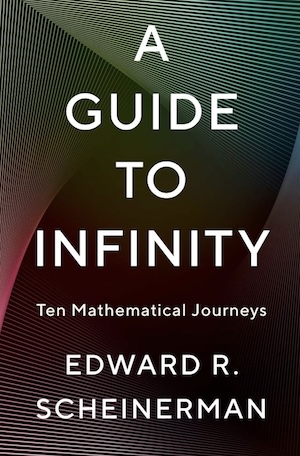
A Guide to Infinity
Edward R. Scheinerman, A Guide to Infinity: Ten Mathematical Journeys, Yale University Press, 192 pages, 6 x 9 inches, 70 b-w illustrations, ISBN: 9780300284799
Get the book →February 17, 2026
02036-scheinerman
The rest of this thread

Edward Scheinerman
Ed Scheinerman is a professor in the Applied Mathematics & Statistics department of the Whiting School of Engineering at Johns Hopkins University where he also serves as a vice dean. Scheinerman studied mathematics as an undergraduate at Brown and as a graduate student at Princeton. His research focus is graph theory—the mathematics that models networks (roads, social, neurons, computers, and so forth). He has twice been honored with the Paul Halmos-Lester Ford award for mathematical writing. He is the author of a variety of books including The Mathematics Lover’s Companion which is also written for a general audience.
Know something the rest of us don't?
Most threads on Rorotoko begin with our invitation. Some begin with a proposal. Both use the same prompts and the same editing, with your own pages in the archive. Proposed threads carry a small Sponsored label and a fee.
Propose a thread →