
David King Dunaway
A Four-Eyed World
I’m extremely near-sighted. I’ve worn glasses since childhood. If I misplaced them, I’d need glasses to find my glasses. My vision is so bad that I need them to cross the street. But I’m embarrassed to say that, for most of my life, I didn’t give them much thought. When I was kicking around the idea of writing a microhistory of glasses, I decided I should try going without them for a week to see what it was like. I had the expected results: accidents small and large, some minor injuries. Maybe it was a crazy idea—cooking on a stove I couldn’t see clearly, for example. I was still able to read a book or newspaper held inches away from my face, listen to the radio, play with my phone. It was still me, just lost in a blur. But you know what surprised me? It was lonely. It made for a lonely week. Needless to say, I now have a newfound appreciation of my glasses.
Throughout my book, I try to emphasize that glasses shape how we see, but also how we’re seen. There’s a lot of science on how glasses-wearers are judged, positively and negatively. They’re supposed to be trustworthy and smart (from all that book-reading), but unsocial, awkward, maybe unattractive, or introverted. Study after study repeat this, even recently. But sometimes it’s not whether one wears glasses but how one wears them. Are the frames distinctly unflattering? Are they whole, askew, or chipped? Some glasses worked well with a wearer’s face; others seemed to wage war on it—and some people seem to revel in that battle. And I have to admit I respect that.
Today, more folks are wearing glasses earlier in life and for longer than ever; nearly half of young adults in the United States and Europe are now nearsighted—double the percentage half a century ago. Nature notes that sixty years ago, the percentage of Chinese youth who wore glasses was 10–20 percent; today it’s up to 90 percent. Australian researchers found a simple, free way to retard myopia: “The more time children spent playing outdoors, the less likely they were to have short-sightedness.” When a child spends time outside during the day, retinal dopamine is released into the bloodstream, which inhibits the elongation of the eyeball that causes myopia. I find these things fascinating, and I hope my readers do, too.
Ongoing thread. More from David King Dunaway to follow.
Curator: Rachel Althof
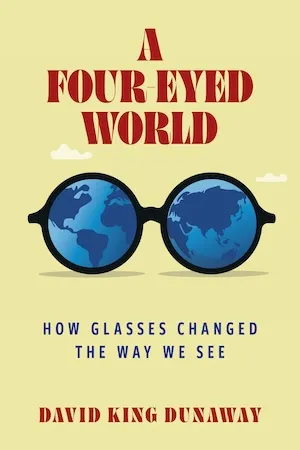
A Four-Eyed World
Dunaway, David King. A Four-Eyed World: How Glasses Changed the Way We See. New York: Bloomsbury Academic, 296 pp.; 6 × 9 in. ISBN 979-8881804824.
Available here →March 4, 2026
20260304-david-dunaway-four-eyed-world
The wide angle
The rest of this thread

David King Dunaway
David King Dunaway is a Professor of English at the Universities of New Mexico and Sao Paulo, Brazil, and the author and editor of 10 books of history and biography including How Can I Keep from Singing: The Ballad of Pete Seeger, Oral History: An Interdisciplinary Anthology, A Route 66 Companion, and Huxley in Hollywood: The Great British Writer’s American Years. His award-winning documentaries are heard on NPR and internationally. He hosted a show on Albuquerque NPR affiliate KUNM for twenty years and has appeared on PBS, CNBC, and CSPAN’s Book TV. He resides in Los Ranchos, New Mexico.
Pull this thread
pulls againstpulls alongside
Glasses shape how their wearers are seen, and eyewear's price is driven by concentration of ownership, not materials.
Nearby KM · Macaroni and cheese endures because it keeps finding new cultural work, not because it tastes good.
Nearby GJ · Beauty companies translated the prejudice that beauty is white into marketing and exported it worldwide.
Nearby DC · Modern consumer society was born out of religious fervor rather than its defeat.
Nearby HJ · Comics are now a primary medium through which a culture awash in objects makes sense of its stuff.
Know something the rest of us don't?
Most threads on Rorotoko begin with our invitation. Any thread can begin with a proposal: you write it with the same prompts every thread answers, and we review it.
Propose a thread →