
A close-up
March 26, 2026
A Four-Eyed World
I’m particularly fond of the part where I look at how glasses are portrayed in books. When eyewear first began to appear in literature, a whiff of sulfur or mystery hung over it; if glasses helped people see, what other powers might they possess? Besides sharpening vision, writers have imagined glasses revealing secrets, allowing 3D vision, performing magic. In fiction, glasses do far more than let people see; they pierce hypocrisy, allow wearers to read people’s thoughts. They helped Sherlock Holmes solve a case and appear in Shakespeare, Dickens, Aldous Huxley, and William Golding’s Lord of the Flies. Post-Harry Potter, prejudice has slowed.
I also like the chapter in which I talk about glasses in popular culture—specifically, the portrayal of those with glasses in film, from Marilyn Monroe hiding them in a strapless evening gown in How to Marry a Millionaire, to Clark Kent ditching them to become Superman, to a bespectacled Princess Mirabel in Disney’s Encanto. All of the glasses stereotypes show up in movies—nerds, geeks, mad scientists, and librarians aching to peel off their glasses and let down their hair. Mr. Magoo was the patron fall-guy of spectacle-wearers. In ads, he appeared in oversized black glasses, which framed his face like a death notice. His problem was that he rarely wore them, so he was a walking disaster movie: power lines fell, buildings tumbled. Even today, many associate him with those who don’t see well. Yet the message can be contradictory: both Nazis and Santa Claus wear wire-rims. Librarians in lenses are kind, but also naughty and sexy. But honestly, when’s the last time you saw a close-up on the big screen in which the actor or actress was wearing glasses?
As for quotes that stand out, here’s one from the preface where I think eyeglasses get their due:
In the 750 years since the invention of spectacles, society’s stake in vision correction has only grown. Visual aids have influenced the history of the world’s commerce, transportation, and education by allowing people to see and work productively into and past middle age.
I may be biased of course: They made it possible for me to see the screen well enough to write this book in my seventies. But their impact on the world is undeniable.
In one chapter I look at AI smart glasses—which are potentially the first pieces of advanced technology people will widely wear. I’ll grant you that it would creepy if someone could check your credit score or marital status on their smart glasses! But they have the potential to be a social good, helping builders, firefighters—anyone needing to work hands-free. AI smart glasses could even help an Alzheimer’s patient find his way home. Of course there’s a possible dark side to them, too. AI smart glasses could bring an end to privacy as we know it, with wearers able to record and even livestream video and audio to mom, the police, and everyone in between, thus turning the public sphere into a goldfish bowl. Scary, but fascinating—and, I think, prescient.
In my book, I also discuss what I look for in a pair of glasses—and I hope it helps other people examine their own thoughts on the topic. I think glasses should feel sturdy, with largish hinges, frames that don’t wobble, and of course lenses held securely. Most important, they should help me see well. I don’t just regard lenses as a fashion statement. That said, some people do—and I explore that in the book as well.
As for the book’s consequences, there’s a part of the preface where I say
Although we make up two-thirds of the US population, we don’t think of ourselves as a distinct community; there is no National Association of Glasses Wearers conference in Vegas.
And it’s true, we identify as many things—our race, our gender, our religion, our sexual orientation, our political leanings. But there are almost 200 million of us here in America, and we don’t identify ourselves as “glassers.” And we should, since they’re a fundamental part of who we are. And maybe, just maybe, they’re a way for us to find common ground.
Curator: Rachel Althof
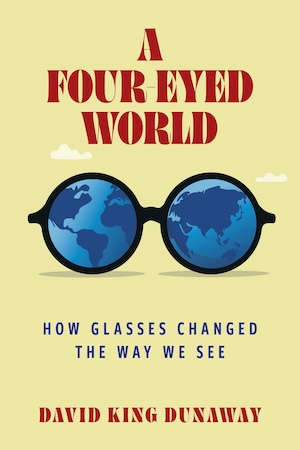
A Four-Eyed World
Dunaway, David King. A Four-Eyed World: How Glasses Changed the Way We See. New York: Bloomsbury Academic, 296 pp.; 6 × 9 in. ISBN 979-8881804824.
Get the book →March 26, 2026
20260326-david-king-dunaway-four-eyed-world-closeup
The rest of this thread

David King Dunaway
David King Dunaway is a Professor of English at the Universities of New Mexico and Sao Paulo, Brazil, and the author and editor of 10 books of history and biography including How Can I Keep from Singing: The Ballad of Pete Seeger, Oral History: An Interdisciplinary Anthology, A Route 66 Companion, and Huxley in Hollywood: The Great British Writer’s American Years. His award-winning documentaries are heard on NPR and internationally. He hosted a show on Albuquerque NPR affiliate KUNM for twenty years and has appeared on PBS, CNBC, and CSPAN’s Book TV. He resides in Los Ranchos, New Mexico.
Feature your book, your art, your project
Publishing with a small press, or on your own?
A Sponsored Thread runs like every other thread on Rorotoko: three parts on three dates, the same editorial review, your own pages in the archive. Marked Sponsored. $199, paid only once accepted.
Get featured →