
Eileen G’Sell
Lipstick
For me to explore the fraught nature of femininity within academia—and which persists within the professional realm more broadly—is something I do not take for granted. It’s something I have been preoccupied by personally and intellectually for at least the last 30 years. I was very lucky to have been an adolescent at a time when Riot Grrrl, feminist alternative culture, and zine culture were really blossoming, which shaped how I perceived both feminism and creative possibilities for women.
I’m probably best known as a film critic and visual art critic, though I’m also a poet with an MFA in poetry. Like Lipstick, my poetry is invested in gender and sexuality. My first poetry book, Life After Rugby, features a classical ballerina on the cover; the juxtaposition of “rugby” and ballet highlights the violence often inherent in both hypermasculinity and hyperfemininity. Both often involve damage to the body, but that violence is of course interpreted differently. In my art and film criticism, I tend to gravitate toward artists concerned with gender and sexuality in non-essentialist ways. In graduate school, I was deeply influenced by Judith Butler and Jack Halberstam, particularly their ideas around gender performativity and deviance.
Though I haven’t written much explicitly about beauty culture prior, Lipstick reflects my earlier writing in terms of its latent preoccupation with gender, sexuality, and class. In a lot of ways, I’m indebted to my students, who’ve written thoughtful papers about beauty culture over the past decade, especially its evolution on platforms like YouTube and TikTok. About five or six years ago, I realized that beauty culture was shifting and that younger generations didn’t see femininity and feminism as incompatible in the same way that my own tends to. The late 20th century was a battlefield for this tension, coinciding with neoliberal economic shifts and women more fully entering the workforce. Having grown up in this period, feminine presentation has always felt like something that could harm my academic reputation—and yet it’s not something I’ve been willing to forfeit. Ironically, my nature is confrontational and competitive—traits coded as masculine—and I’ve been discouraged from embracing them because of my gender. Of course, femininity does not have to mean passivity. Lipstick itself can be bright, disruptive, and charged.
While researching the book, I learned so much about the connections between sex work stigmas, classism, and early feminist literature. Incorporating the voices of diverse women today also strengthened the book; these voices often serve to reflect how these connections haven’t entirely disappeared. To be sure, I don’t see the book as pro-lipstick; I deliberately included perspectives of people who dislike lipstick and makeup. Lipstick isn’t about promoting beauty consumption or celebrating one attitude over another—but rather understanding why adornment carries such emotional and political meaning. I identify as a leftist, and while my politics appear subtly in the book, class is part of the conversation in a way that I hope remains accessible.
Ongoing thread. More from Eileen G’Sell to follow.
Curator: Bora Pajo
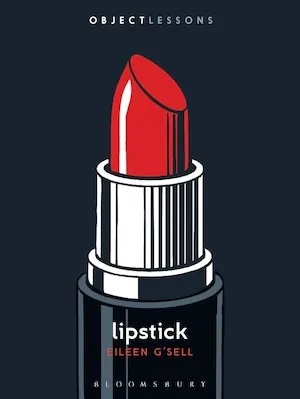
Lipstick
G’Sell, Eileen. Lipstick. Object Lessons series. New York: Bloomsbury Academic, 2026. 200 pp.; 4.8 × 6.5 in. ISBN 979-8765135587
Available here →March 7, 2026
20260307-eileen-gsell-lipstik-wide-angle
The wide angle
The rest of this thread

Eileen G’Sell
Eileen G’Sell is a poet and culture critic who mingles the literary with the critical, the creative with the academic, focusing on gender, sexuality, and economic class. G’Sell’s poetry has appeared in Poetry magazine, Fence, DIAGRAM, Oversound, The Rumpus, and The Boston Review; recent essays have appeared in The Baffler, The Hopkins Review, The Los Angeles Review of Books, Current Affairs, Jacobin, and The Chronicle of Higher Education. She serves as movie critic of The Hopkins Review, and makes frequent contributions to Hyperallergic, Reverse Shot, and The Riverfront Times. In 2023, she received the Rabkin Foundation award for visual arts journalism. She is a Teaching Professor of writing and media studies at Washington University in St. Louis.
Pull this thread
The tension between femininity and feminism is a late-twentieth-century artifact, and it is already dissolving among the young.
Know something the rest of us don't?
Most threads on Rorotoko begin with our invitation. Any thread can begin with a proposal: you write it with the same prompts every thread answers, and we review it.
Propose a thread →