
A close-up
March 31, 2026
Lipstick
The Object Lessons series excels at connecting objects to larger implications. Ultimately, I hope my readers will become more curious about how something as banal as lipstick connects to sexuality, power, gender identity, and class.
Even though many women don’t wear lipstick regularly, sales haven’t declined. That contradiction is fascinating. I see the book as a provocation—one that leads to productive arguments between women and challenges men’s frequent discomfort with the concept of femininity as artifice. I hope queer readers gravitate toward the book as well; lipstick itself is rich with queer potential, which Lipstick explores at length. Beauty culture is tied to so many systems of power and, for that reason alone, warrants serious critical attention.
Lipstick is a catalyst for thinking about the difference between art and artifice, and how that distinction is gendered. I’m also researching glamour, and see the book as part of a larger conversation which I’d like to expand upon in the future. I hope beauty culture can also be taken more seriously in the United States, academically. I hope Lipstick contributes to a more rigorous intellectual embrace of questions related to femininity.
I dedicated the book to my mother, who rarely wears makeup, but supported my interest in all forms of self-expression when I was young. The older I get, the more I appreciate how tolerant she was in this respect. I hope the book prompts both tolerance and curiosity for different forms of feminine expression.
Curator: Bora Pajo
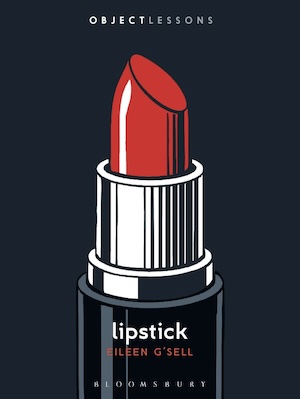
Lipstick
G’Sell, Eileen. Lipstick. Object Lessons series. New York: Bloomsbury Academic, 2026. 200 pp.; 4.8 × 6.5 in. ISBN 979-8765135587
Get the book →March 31, 2026
20260331-gsell-eileen-lisptick-closeup
The rest of this thread

Eileen G’Sell
Eileen G’Sell is a poet and culture critic who mingles the literary with the critical, the creative with the academic, focusing on gender, sexuality, and economic class. G’Sell’s poetry has appeared in Poetry magazine, Fence, DIAGRAM, Oversound, The Rumpus, and The Boston Review; recent essays have appeared in The Baffler, The Hopkins Review, The Los Angeles Review of Books, Current Affairs, Jacobin, and The Chronicle of Higher Education. She serves as movie critic of The Hopkins Review, and makes frequent contributions to Hyperallergic, Reverse Shot, and The Riverfront Times. In 2023, she received the Rabkin Foundation award for visual arts journalism. She is a Teaching Professor of writing and media studies at Washington University in St. Louis.
Feature your book, your art, your project
Publishing with a small press, or on your own?
A Sponsored Thread runs like every other thread on Rorotoko: three parts on three dates, the same editorial review, your own pages in the archive. Marked Sponsored. $199, paid only once accepted.
Get featured →