
Danny Bate
Why Q Needs U
Like a range of mighty mountains, human civilisation is made up of obvious peaks that define their era, but also a growing and unappreciated base on which later achievements can stand. I see the alphabet as an essential layer within that foundation. At a young age, we learn our ABCs, and then spend the rest of our lives reading and writing those letters, with little thought to why they look and work the way they do.
This, I should stress, is a good thing! It’s a sign of the alphabet’s success that its letters fit so unobtrusively into our lives. With the alphabet securely under our belts, we can move on to composing our novels, poems, articles and shopping lists. But there are also benefits to reacquainting yourself with something so fundamental in our everyday lives.
One is simple joy, in seeing the familiar afresh, recognising connections, and basking in human brilliance. It may not immediately improve your life to learn that the letter J emerged from I, or that five members of the English alphabet (F, U, V, W and Y) descend from a single ancestral letter. Nonetheless, they’re fun facts, and the history behind them joins Modern English to languages and peoples far away in time and space.
But another benefit comes from an appreciation of how the alphabet works (or sometimes doesn’t work), because we today are a chapter in its long story. The alphabet is a testament to innovation, and every population that has embraced it has the right and means to make adjustments. It looks stable, but nothing about it is fixed. Letters have changed in terms of how they look, what they’re called, what they stand for, and where they come in the alphabetic order. Letters have been born, died, and even given birth to further letters during the four millennia since the alphabet’s formation.
Many of these changes have been responses to shifts in speech – a natural, endless process that demands updates in spelling. If not, we risk straining the relationship between the sounds from our mouths and the symbols on our page. English itself could do with a tidy-up. Its silent letters (as in hour, doubt, night), Magic Es (as in late, name, kite) and imported spellings (compare the J in jam, deja-vu and fajita) stress the system and its learners. We manage, but if we want to make changes, the power is in our hands.
Why Q Needs U is my way of making that reintroduction between readers and their alphabet. It’s a book that sets out, in twenty-six chapters (appropriately), to answer the questions of where the alphabet comes from, and why English employs it in its distinctive way. One of these questions alone would provide more than enough material for a book, but I thought that would leave the reader with only half a story. Why Q Needs U instead tackles them together, to offer a complete A- Z of the ancient technology that you’re reading right now.
Ongoing thread. More from Danny Bate to follow.
Curator: Bora Pajo
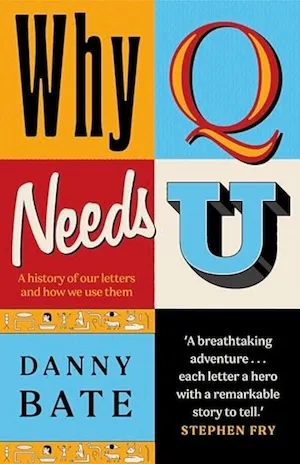
Why Q Needs U
Bate, Danny. Why Q Needs U: A History of Our Letters and How We Use Them. Blink Publishing (Bonnier Books UK), 2025. ISBN 9781785307430
Available here →March 13, 2026
20260313-bate-danny-why-q-needsu
In a nutshell
The rest of this thread

Danny Bate
Danny Bate is a linguist and writer. Following a BA and MPhil, he studied for a PhD with the University of Edinburgh, graduating in 2024. His specialisms are historical languages, the Indo-European language family, and word order. Over the course of his time at university, he also pursued a passion for public linguistics – sharing the field with a general audience, through text, audio and video. This vocation has most recently expressed itself through Why Q Needs U, a new book about the alphabet and the English language, named by The Economist as one of its books of 2025.
Pull this thread
The alphabet only looks fixed, and the right to adjust its letters belongs to every population that uses them.
Know something the rest of us don't?
Most threads on Rorotoko begin with our invitation. Any thread can begin with a proposal: you write it with the same prompts every thread answers, and we review it.
Propose a thread →