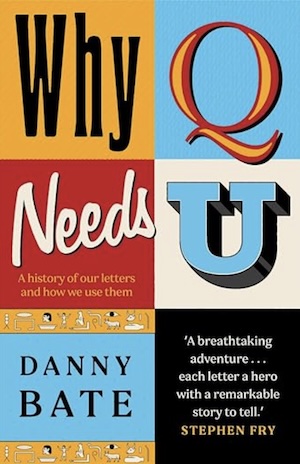
Why Q Needs U is a contribution to public linguistics, which I consider to be going through a bit of a golden era. Linguistics – the scientific study of language – is booming in non-specialist spaces, from blogs to bookshops. There’s an appetite for accessible information that addresses this thing called language that we humans all do. What I can best supply to this demand is history.
The history of a language and languages of history are my loves. Through this long-held devotion, my work offers a distinct perspective of the human world: a richly complex network of connections and interactions, with little respect for national borders, that stretches far back into prehistory. My particular discipline of linguistics has no trouble linking Ireland to India or Norway to Nepal, thanks to a shared linguistic ancestry among speakers.
But how to present this perspective to the public? The public linguist needs to meet their audience at their doorstep. I seized on the alphabet as a portal into the linguistic past; our letters are everywhere in our world but usually far from our thoughts. The simple suggestion that the alphabet has a complex history might be enough to hook the reader. I then reel them in through tales of the characters that have starred in the story of the alphabet (Egyptians, Phoenicians, Greeks) and of the English language (Angles, Saxons, Normans). Before they know it, they’ve been inducted into historical linguistics.
But there is a second aim behind Why Q Needs U. Beyond narrating the past, I also want to contrast it with the present. As mentioned, there have been distinct chapters within the alphabet’s story, when external forces, like technology, have acted on it. Our day is no exception; we are living through what historians of the future will recognise and categorise as a particular era of writing.
So much of historical writing has an organic quality, and consequently a disunited appearance, as people wrote without a rule book. Writing operated within a web of influence, yes, but not through compulsion to write according to one particular standard. Now, by comparison, a standard has emerged and it seems all-victorious. Dictionaries, spell-checkers, predictive text and AI every second reinforce a particular way to render English in writing.
Consequently, English has at a glance never seemed more united – but a glance only reveals half the story. What the eye misses the ear picks up: the spoken language is tearing at the seams. Accents and dialects of English continue to emerge and develop, but standard spelling doesn’t acknowledge them. When speech slips away from the alphabet, it threatens its foundational principle: to assign sounds to symbols. If this continues, won’t the whole house come crashing down? Perhaps a review of the alphabet’s ancient history is now timely.
Ongoing thread. More from Danny Bate to follow.