In a nutshell
March 27, 2026
Caribbean Blood Pacts
Caribbean Blood Pacts is a new history of the death of Guatemalan democracy in the early 1950s. In 1944, Guatemalans ousted their dictator and launched their ten-year Guatemalan Revolution. However, the Central Intelligence Agency unleashed its covert Operation PBSUCCESS, and the resulting psychological warfare convinced Guatemala’s own military to overthrow its government. Obviously, historians have long questioned why the US government chose to destroy this Central American nation’s democratic experiment.
Caribbean Blood Pacts, though, reveals how forces outside the United States propelled this history. Guatemalan reactionaries loathed their country’s developments and immediately sought to restore the status quo. Caribbean Basin dictators feared Guatemala’s democracy for bringing together much of the region’s antifascist dreams following the Second World War. The United Fruit Company, the Boston-based corporation known for the Chiquita banana, soon denounced the country’s new labor reforms. Even the British government opposed the Guatemalan Revolution’s anticolonial ideals.
As a result, all of these forces attacked Guatemala’s democracy. Dictators funded reactionaries’ border invasions, domestic uprisings, and air-bombing plots. United Fruit hired public relations experts who created propaganda characterizing Guatemala as a Soviet beachhead in the Caribbean. The company’s lobbyists provided memoranda and reports to US Congresspersons, Republicans and Democrats, that became the fodder for anticommunist denunciations and newspaper articles. British intelligence circulated more propaganda and initiated an arms embargo. Into the early 1950s, these machinations undermined and radicalized Guatemalan politics as citizens questioned or doubted their own governments for instituting constitutional suspensions due to the number of antigovernment conspiracies and plots.
These forces built the very foundations of the CIA’s operations. The first plot, Operation PBFORTUNE, was started by the dictators and backed by United Fruit. Operation PBSUCCESS relied heavily on those dictators and reactionaries while receiving United Fruit’s and the British government’s endorsements. Essentially, the US government’s resources realized the longstanding desires of a counterrevolutionary consortium including multiple dictators and a transnational corporation.
Ongoing thread. More from Aaron Coy Moulton to follow.
Curator: Rachel Althof
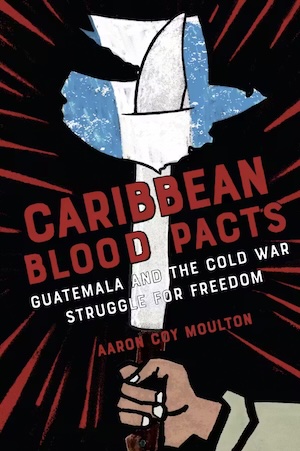
Caribbean Blood Pacts
Moulton, Aaron Coy. Caribbean Blood Pacts: Guatemala and the Cold War Struggle for Freedom. Cornell University Press, 2026. Print. ISBN 9781501784804
Get the book →March 27, 2026
20260327-aaron-moulton-caribbean-blood-pacts
The rest of this thread

Aaron Coy Moulton
Aaron Coy Moulton is Associate Professor of Latin American History at Stephen F. Austin State University. His award-winning research on transnational networks of dictatorships and exiles has appeared in Cold War History, The Americas, and The Journal of Latin American Studies. His scholarship has been supported by multiple historical institutions and organizations, most recently, The Huntington Library, the Hoover Institution, and Lamar University’s Center for History and Culture of Southeast Texas and the Upper Gulf Coast.
Feature your book, your art, your project
Publishing with a small press, or on your own?
A Sponsored Thread runs like every other thread on Rorotoko: three parts on three dates, the same editorial review, your own pages in the archive. Marked Sponsored. $199, paid only once accepted.
Get featured →