
Aaron Coy Moulton
Caribbean Blood Pacts
The history uncovered in Caribbean Blood Pacts is inspired by another history, that of foreign powers and elites who profit most off the US government’s policies. United Fruit could not tolerate any challenge to its power in Guatemala, so it had lobbyists and public relations experts spread propaganda from Congress throughout the United States. Dictators, as did the British government, spent a decade claiming any opposition was communist. These efforts directly shaped the US government’s policies. While benefiting these forces, the coup left a devastating mark on Guatemala that has contributed to transnational criminal organizations, immigration, and more.
A perfect example of such interplay can be found in the files of Republican Senator Alexander Wiley of Wisconsin. Wiley served as the Chair of the Senate Foreign Relations Committee. In the early 1950s, he became one of the most vocal critics of Guatemala’s governments, networking with reactionaries and Trujillo. Most notably, the Counsel of Wiley’s Committee was Julius Cahn. As I uncovered, Cahn was working closely with Edward Bernays, the public relations expert who was retained by United Fruit. On the company’s behalf, Bernays spread propaganda through US newspapers, a newsletter, and more. The entire time, Bernays and Cahn collaborated against Guatemala’s government by writing up propaganda and creating an anticommunist handout for the American Legion.
At one point, a Wisconsin citizen questioned whether Wiley received his information from the United Fruit Company. Wiley refuted the allegation and swore that he was no puppet of United Fruit; however, the entire time, Cahn was indeed working with Bernays and using propaganda, article, and more produced by United Fruit’s allies. The US official working for the Senate Foreign Relations Committee and handling Wiley’s speeches was, in fact, an ally of the company.
I hope my work inspires further research into how the US government, even when appearing to have good intentions, has both purposefully and inadvertently helped others, often at the expense of our own citizens or those abroad.
Curator: Rachel Althof
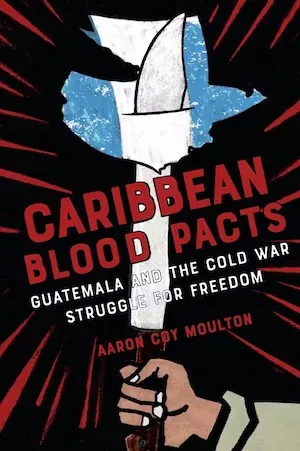
Caribbean Blood Pacts
Moulton, Aaron Coy. Caribbean Blood Pacts: Guatemala and the Cold War Struggle for Freedom. Cornell University Press, 2026. Print. ISBN 9781501784804
Available here →April 26, 2026
20260426-aaron-moulton-guatemala-and-the-cold-war
A close-up
The rest of this thread

Aaron Coy Moulton
Aaron Coy Moulton is Associate Professor of Latin American History at Stephen F. Austin State University. His award-winning research on transnational networks of dictatorships and exiles has appeared in Cold War History, The Americas, and The Journal of Latin American Studies. His scholarship has been supported by multiple historical institutions and organizations, most recently, The Huntington Library, the Hoover Institution, and Lamar University’s Center for History and Culture of Southeast Texas and the Upper Gulf Coast
Pull this thread
Caribbean dictators, Guatemalan reactionaries, United Fruit and Britain plotted against Guatemala's Revolution years before the CIA did.
Know something the rest of us don't?
Most threads on Rorotoko begin with our invitation. Any thread can begin with a proposal: you write it with the same prompts every thread answers, and we review it.
Propose a thread →