
The wide angle
April 1, 2026
Breathing Space
I’ve long had a penchant for the analogies we draw between our bodies and the buildings we inhabit. I’ve also long been interested in the act of breathing, but honestly not so much in a physiological sense and more so through my own physical practices, from swimming to yoga and meditation. Breathing is so vital that it usually happens unconsciously and automatically. We rarely notice it unless something goes wrong. The large portion of this research happened long before the COVID-19 pandemic, which suddenly refocused public attention to the workings of the lungs and serves as a poignant reminder of the issues this book explores.
I began this research for my doctoral thesis at Yale in 2015 and was drawn to the writings of Sigfried Giedion, the Swiss art historian and architecture critic of the modern movement who taught at Harvard in the late 1930s. In one of his books, laced with references to air and airflow, he describes a defining feature of modern space as the interpenetration of inside and outside. For Giedion, this largely meant the dissolution of exterior walls through all-glass surfaces. Yet this is essentially what our lungs do: they blur the boundary between inside and outside and, although they are internal organs, maintain a constant connection to the external world. I began to see an analogy between the lungs, as the central organ of our respiratory system, and the ways in which the historiography of modern architecture represented space. Looking at other contemporary sources from a range of disciplines, I found illustrations of lungs and lots of references to breathing, both metaphorical and literal. This led me to trace the contours of what I call respiratory modernism, as I tried to understand why some of the buildings I knew were designed the way they were. These ideas shaped designs at different scales, from the layout of floor plans to the inventive mechanisms used to open windows. Today, windows can all too often no longer be opened, a condition particularly debilitating during the pandemic.
Bodies and buildings share the same atmosphere, yet this atmosphere is not fixed. It varies from place to place, and our understanding of it has changed over time. Through breathing, our lungs are directly connected to the surrounding air, while architecture plays an important role in controlling how air moves between bodies and their environments: it mediates this exchange. Because of this close relationship between bodies, architecture, and the environment, the book often treats breathing and ventilation together, even though they are usually seen as belonging to separate fields—physiology and architecture.
Ongoing thread. More from Tim Altenhof to follow.
Curator: Bora Pajo
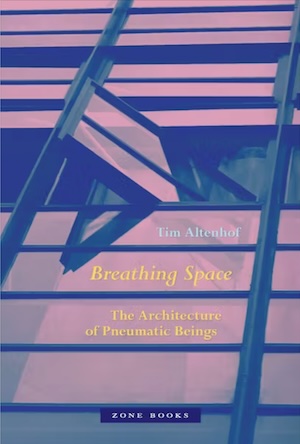
Breathing Space
Altenhof, Tim. Breathing Space: The Architecture of Pneumatic Beings. Zone Books, 2026. ISBN 978-1-945861-11-6
Get the book →April 1, 2026
20260401-altenhof-tim-on-breathing-space
The rest of this thread
.png)
© Bengt Stiller
Tim Altenhof
Tim Altenhof is a Berlin-based architect, teacher, and author, currently serving as a senior scientist in architectural theory at the University of Innsbruck. He received his Ph.D. from Yale University, where his dissertation was awarded the Theron Rockwell Field Prize in 2018. An excerpt of this work also won the Bruno Zevi Prize 2018. In 2022, Tim was an International Fellow at the Institute of Advanced Study in the Humanities (KWI) Essen. His writings have appeared, amongst others, in Log, 21:Inquiries into Art, History, and the Visual, and Journal of the Society of Architectural Historians.
Propose a thread
Know something the rest of us don't?
Most threads on Rorotoko begin with our invitation. Some begin with a proposal. Both use the same prompts and the same editing, with your own pages in the archive. Proposed threads carry a small Sponsored label and a fee.
Propose a thread →