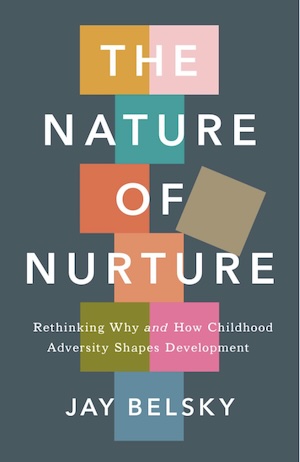
I was schooled—and embraced for a long time—the traditional idealized and romanticized view of how nurture shapes children’s development. But eventually I encountered evolutionary mindedness applied to thinking about the effects of childhood experience. This new view of life intrigued me but did not persuade me, so as a developmental scientist I set out to test it to see if it “had legs”. This was an exciting process and as the evidence emerged that early-life adversity accelerates sexual development, I became a “believer”. But just so I am understood this was not a matter of faith, but of scientific testing.
In some ways this new way of seeing child development has much in common with traditional ways, implying for example, that if we don’t want children to develop in certain ways, often resulting from childhoods we would not wish on others, early intervention makes good sense. At the same time, however, evolutionary understanding should lead us to expect that such interventions will not be as successful as we have hoped, a long-established fact which is mostly ignored or explained away. None of this, however, implies that we should only support and assist more susceptible children, because in an affluent society every child has a right to a childhood of safety and security. Why? Because they never asked to be here! Bottom line: there are clear points of convergence between traditional and evolutionary ways of thinking about effects of childhood on children’s development. Thus, the evolutionary approach does not repudiate prevailing ways of thinking in its entirety; in fact it expands it. For me it was a matter of seeing in color what had otherwise only been viewed in black and white.
Ongoing thread. More from Jay Belsky to follow.