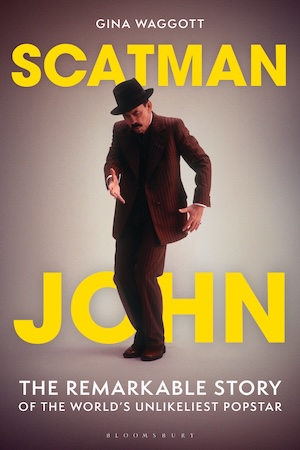
If a browsing reader were to open the book at random, I’d hope they land in Chapter 24, which recounts John’s appearance on the Norwegian TV show Rondo in 1995.
At this point, John is riding an extraordinary wave of fame across Europe, but the press is skeptical. Rather shockingly, some believe his stutter is fake - a gimmick designed to sell records. It was the 90s, and it was still acceptable for TV hosts to mock or imitate John’s stutter, which they routinely did.
Fast forward to the performance. The show insists on John both speaking and performing live. It’s just John, a keyboard, and a microphone in front of millions. John has spent his entire life hiding behind the piano, letting his fingers do the talking. Now he has a choice: retreat to safety using a backing track, or step fully into view as himself - stutter and all.
He chooses himself.
What follows is a high-wire act: a live, jazz-inflected version of “Scatman” built almost entirely on improvisation. The band doesn’t know where he’s going but they roll with it. The arrangement could collapse at any moment. As he plays, you can see him shedding layers in real time, giving way to something wild, joyful, and free.
When he speaks to the host before playing, he stutters overtly and comments on it, saying that his greatest problem has now become his greatest asset, that he’s taken his stutter and used it to scat-sing. It’s the moment he owns it, instead of it owning him.
This is the entire book in miniature: the terror of exposure, the ecstasy of surrender, and what happens when shame turns into power. It’s the moment John stops performing a version of himself and starts performing as himself - not despite his stutter, but because of it.
The clip described in that chapter resurfaces online and goes viral every few months. It still captures people. My hope is that, with the book as context, readers understand what it cost John to reach that moment, and how much he deserved that success.
If a reader were browsing in a bookstore, I would hope they encounter any number of the wonderful quotes from John himself. After almost killing himself with drugs and alcohol, John is invited to speak at a convention for people who stutter. He tells the audience: “You are looking at a walking, talking miracle. Because I should be dead.” He meant it literally - he had been resuscitated on his heroin dealer’s floor, brought back only by CPR.
Another comes near the end of his life, just four years after his fame. Rather than bitterness about terminal cancer in his fifties, he said: “I’ve had the very best life. I have tasted beauty.”
My hope is that this book functions as a manual for hope - especially for outsiders, late bloomers, addicts, anyone carrying shame or difference, and those taught to hide or mask parts of themselves just to survive. I want it to change how we think about disability, away from pity and narratives of “overcoming,” and toward agency, complexity, and power.
I want stuttering children to see themselves the way John saw them: not broken, just different - and just as entitled to speak the way they speak as anyone else. I want people who believe it’s “too late” to know the story of a middle-aged pop star who changed millions of lives only after nearly destroying his own.
Most of all, I want readers to understand that Scatman John was not a novelty act, despite the lightweight pop music through which he eventually found his calling. He was a deeply wounded man who alchemized pain and trauma into an anthem that gave millions of people permission to finally be themselves. Including me.