
Gina Waggott
Scatman John
In the 1990s, a middle-aged, stuttering jazz pianist unexpectedly became the best-selling male artist in Europe, outselling even Michael Jackson. His name was John Paul Larkin. But the world knew him as Scatman John. John was a lifelong stutterer, a recovering addict, and a musician who spent decades playing jazz in obscurity. Then, in his fifties, he achieved sudden global fame in the alien genre of Eurodance - or house music, as it’s known in the US. His stutter made him a remarkable scat singer: the freezing of his spoken syllables translated into astonishing speed and precision when he sang. Fame arrived when he alchemized his stutter into a global hit, Scatman (Ski-Ba-Bop-Ba-Dop-Bop).
Ostensibly, this authorized biography tells the story of a man who turned what nearly destroyed him - his stutter - into the thing that set him free. But at its core, this is a book about shame, visibility, and the cost of hiding who you really are. Although Scatman John remains culturally visible today (his music has been streamed more than half a billion times and is all over the internet as memes), his life beyond the so-called “novelty hits” has never been fully told. Until now.
I knew John, and I was given access to his unpublished memoir fragments, private letters, and the inner circle of friends, family members, and musicians who knew him best. I traced his life from a deeply traumatic childhood through addiction, recovery, and finally, international fame. When John became “the Scatman,” it was not the gimmick people assumed, but the public culmination of a lifelong internal struggle, and a radical act of self-acceptance made visible.
As a stutterer myself, I want readers not simply to understand stuttering intellectually, but to feel what it is like to stutter. Stuttering is a neurological condition, not a psychological one, and stigma and misunderstanding remain widespread. The book argues that what the world labels a ’defect’ can become a source of strength, agency, and connection. John came to believe his stutter was not a problem to be solved, but a way of processing his creativity, spirituality, and belonging.
I hope readers approach this book with curiosity, not necessarily nostalgia for novelty ’90s pop songs, though that’s okay too! You don’t need to love that era, the music, or even Scatman John himself to recognize the human story underneath - about what happens when we stop running from ourselves, and from unhelpful labels society places on us.
Curator: Bora Pajo
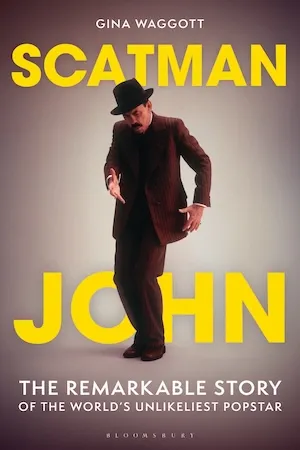
Scatman John
Gina Waggott Scatman John: The Remarkable Story of the World's Unlikeliest Popstar, Bloomsbury Academic, 288 pages, ISBN: 979-8881807078
Available here →February 10, 2026
20260210-gina-waggott-scattman-john
In a nutshell
The rest of this thread

Gina Waggott
Gina Waggott is a writer, editor, and former BBC professional with a background spanning broadcasting, journalism, and disability advocacy. Her work has been published in The Times, The Sunday Times, Reader’s Digest, and many more. A covert stutterer, she is active in several nonprofits serving the global stuttering community and its allies. Visit ginawaggott.com.
Pull this thread
pulls againstpulls alongside
Scatman John's stutter was the mechanism of his art, and overcoming is the wrong frame for disability.
Nearby MF · Hip-hop is not a youth movement and has not been one for decades.
Nearby BS · Bernstein's politics and his music were a single life.
Nearby KV · Black social dance from jazz through hip-hop is one continuum, and it made the American body.
Nearby RS · Prince's innovation was blending the Black and white sounds of a city that segregation had split in two.
Nearby EW · Todd Haynes's I'm Not There is a more insightful account of Dylan's life than A Complete Unknown.
Know something the rest of us don't?
Most threads on Rorotoko begin with our invitation. Any thread can begin with a proposal: you write it with the same prompts every thread answers, and we read it.
Propose a thread →