
Zheng Liu
Cultural Mavericks
Cultural Mavericks tells the lesser-known stories of a group of self-proclaimed ‘independent bookstores’ that has arisen across China over the past two decades. In the West, such retailers represent an alternative to corporations and chains. In China, by contrast, they differentiate themselves not only from the state-owned bookstore but also from other privately owned shops through an emphasis on intellectual independence, curated taste, and the free exchange of ideas.
This book was inspired by several central questions: In an age of digital reading and e-commerce, what has driven the proliferation of these establishments? Who are the individuals and organisations running or financing these businesses, and what are their motives? How do these bookstores survive, and matter, in an environment marked by shifting market conditions, evolving ideological boundaries, and changing public expectations about the social and economic role of cultural spaces? Ultimately, what do the rise and impact of independent bookstores tell us about the changing nature and shifting dynamics of China’s book industry and book culture more broadly?
Drawing on more than a decade of immersive qualitative research using interviews, observations, and extensive documentary analysis, I demonstrate how independent bookstores, as both dedicated cultural institutions and resilient business enterprises, balance economic imperatives with a commitment to cultural autonomy. I develop the concept of ‘culturally adapted strategy’ to explain how they creatively engage with political narratives, draw moral legitimacy, and harness cultural resources to carve out a unique identity, one that affords them an advantageous market position in the highly competitive industry of book retailing.
In addition to offering an in-depth account of a hitherto largely overlooked cultural phenomenon in China’s cultural sphere, this book challenges the common assumption in anglophone scholarship that China’s cultural industries must be understood through the lens of the binary of state control and market resistance. Instead, I argue that independent bookstores engage with politics as a strategic means of differentiating themselves from competitors, primarily the state-owned Xinhua Bookstore and the usual, market-oriented privately owned bookshops. Rather than overstating their political motives and political significance, I show how their political involvement is underpinned by a critical set of cultural and economic considerations. The book thus offers a new insight into the real way in which culture, commerce, and politics intersect to shape cultural production in contemporary China.
Curator: Rachel Althof
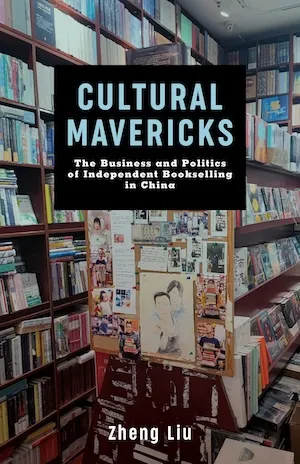
Cultural Mavericks
Liu, Zheng. Cultural Mavericks: The Business and Politics of Independent Bookselling in China. Columbia University Press, 264 pages, ISBN: 9780231200134
Available here →May 2, 2026
20260502-zheng-liu-business-and-politics
In a nutshell
The rest of this thread

Zheng Liu
Dr Zheng Liu is a Lecturer in Innovation Management at the University of Bristol Business School. She received her PhD in Sociology from the University of Cambridge and previously studied and taught at Tsinghua University in Beijing. Trained as a cultural and economic sociologist, her research examines how cultural systems, technological innovations, and business practices intersect to shape contemporary social and economic life. Her recent work focuses on (a) examining how social structural forces shape AI innovation, and (b) how AI is transforming book publishing in China.
Pull this thread
pulls againstpulls alongside
Chinese independent bookstores engage with politics as a strategy of market differentiation, and reading them as resistance overstates their politics.
Against KV · Black social dance from jazz through hip-hop is one continuum, and it made the American body. On: Subcultural style, leisure and consumption are forms of political resistance
Against CJ · For unemployed educated young men in north India, waiting is a fertile condition that breeds friendships and protest. On: Subcultural style, leisure and consumption are forms of political resistance
Against SB · Late-GDR experimental artists worked through state art schools and official venues, and the Stasi's outsized presence was ineffective. On: Subcultural style, leisure and consumption are forms of political resistance
Alongside JC · Pop around 1989 registered the disappearance of the century's organizing antagonism, and the cost was the capacity to think historically. On: Subcultural style, leisure and consumption are forms of political resistance
Alongside KP · The evidence that zoot suiters wore the style as a gesture of refusal is slight and ambiguous. On: Subcultural style, leisure and consumption are forms of political resistance
Alongside FG · Sport opened to marginalized athletes in the 1960s and 1970s on white owners' terms, and commercialization then undid the gains. On: Subcultural style, leisure and consumption are forms of political resistance
Know something the rest of us don't?
Most threads on Rorotoko begin with our invitation. Any thread can begin with a proposal: you write it with the same prompts every thread answers, and we review it.
Propose a thread →