
Nicholas Tochka
The Musical Lives of Charles Manson
As I was working on this book, a close friend told me that, while reading an early draft, they felt themselves come “unstuck” as the narrative ground at one point seemed to begin shifting beneath their feet, then disintegrating. I’ve surely never received a lovelier comment than that. If a reader who picks up this book has a similar moment, a moment where form (the written page) generates a felt experience of content (argument) – well, what author could ask for anything more?
My real desire, however, is that someone may decide to reread certain sections after finishing the whole thing. Academic books, including my earlier ones, are written to be endured. An academic book usually compels you to crack open its osteal prose (as painlessly as possible), in order to gulp down the rich marrow-information within (as quickly as possible).
For sure, vanity may be dictating my secret desire that people might reread this book. But so too does my central premise, as outlined in a note at the end:
To really understand a piece of writing, you must grasp its unity. And that unity can be grasped only by discovering how a work is one—and in that same moment, many. This advice can be found in Mortimer J. Adler’s classic How to Read a Book (1940), overhauled for publication in 1972 with Charles Van Doren. And it’s an example of the central problem underlying No Sense Makes Sense: namely that, during the so-called American century, an exegetical impulse—characterized by the compulsion to “read between the lines,” to transform all phenomena, written and unwritten, into “texts” that can be parsed—came to dominate how we make sense of our worlds.
A historical study of that impulse to interpret and make sense of experiential phenomena, in this case, rock music, as well as an experiment in social interpretation, this book – I hope – will allow rock fans, academics, and true-crime afficionados alike to revisit one of the most closely chronicled, and hotly debated, events of the American century.
Curator: Bora Pajo
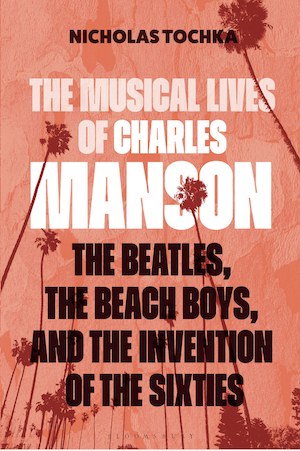
The Musical Lives of Charles Manson
Tochka, Nicholas. The Musical Lives of Charles Manson: The Beatles, the Beach Boys, and the Invention of the Sixties — or, No Sense Makes Sense. Bloomsbury Academic, 2026. ISBN 9781501384554
Get the book →April 5, 2026
20260516-nicholas-tochka-on-musical-lives-charles-mansion
A close-up
The rest of this thread

Nicholas Tochka
Nicholas Tochka is an ethnomusicologist and historian who writes about the politics of popular music in the postwar world. His previous books have examined light music in the socialist and postsocialist Balkans, the career of Albanian pop star and media mogul Ardit Gjebrea, and the politics of rock music in the Cold War United States. Originally from Boston, Tochka now works and lives in Australia. He plays bass, a bit of guitar, and ukulele.
Know something the rest of us don't?
Most threads on Rorotoko begin with our invitation. Some begin with a proposal. Both use the same prompts and the same editing, with your own pages in the archive. Proposed threads carry a small Sponsored label and a fee.
Propose a thread →