
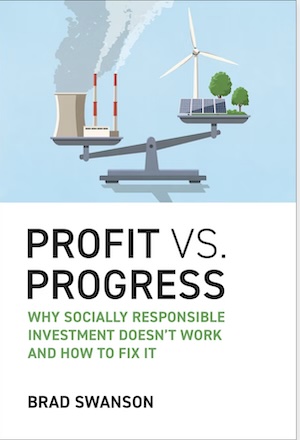
In one sense, I’ve been writing the book for more than twenty years. During that time, when my team and I were managing socially responsible investment funds, I saw that our ambitions were often frustrated by reality. We promised our investors that we would strive to deliver both market-rate financial returns and significant social impact. But in trying to put this into practice, we learned the truth of a commonsense observation — companies that maximize social value cannot simultaneously maximize financial value, and vice-versa. The trade-off exists, and makes a mockery of the mantra of socially responsible investing: "Doing well by doing good."
Stung by uncertainty, I began doing research into the larger world beyond my own funds. I doubled down as I began teaching an undergraduate course in socially responsible finance. Starting with "impact investing" (which was my segment of the industry), I ventured into "ESG," standing for Environmental, Social & Governance, and then into Green Bonds, carbon credits, and the political theater of "woke capitalism." (I deal with all these in the book.)
The more complex my field of study became, the simpler the underlying truths. Corporations exist, and have always existed, solely to deliver value to shareholders. This is a core strength of the capitalist system, and a key to its prodigious productivity. But the corollary is that corporations are amoral. They will not voluntarily retool the machinery of profit to better serve the needs of society. If we want that to happen, we have to turn to laws and regulations. We need to be careful, however, not to dilute the innovation and energy arising from freely competitive markets.
As I deconstructed the products of socially responsible finance I was struck by the willful blindness of the community. Yes, people make their living from managing sustainable funds, doing analysis and research, administering the system, rating companies on social criteria, etc. They have a vested interest in its credibility. But finance people are generally known for critical thinking and challenging assumptions — I have not seen enough of that in my corner of the industry.
The book, therefore, has two audiences. One is the general public, readers who want to understand why this massive financial industry is not delivering on its promises. Some of them may even have a portion of their own savings in sustainable funds. But whether they do or not, they should understand how the failure of sustainable finance sets us all back. For this reason, I leave out financial geekery and try to explain issues in clear, non-technical language.
The other audience is my colleagues in sustainable investing, and the larger industry of asset management and finance. I hope the book induces some of them to question their allegiance to a doubtful creed, and to reconsider the role of finance in serving the public good.
Above all, I hope those who pick it up have a good read, and are happy to be exposed to new ideas about a topic that is hugely important but often taken for granted.

.png)