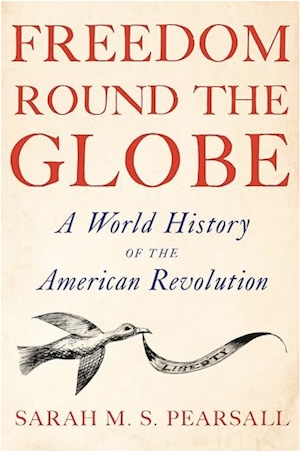
Freedom Round the Globe is all about the wide angle! Every chapter begins outside of the thirteen colonies in order to provide new perspectives on the usual narrative of the American Revolution. The book brings a world historical perspective to what is commonly understood to be a national, even local struggle. Of course the American Revolution was a critical national and local event, and those dynamics—many of which have been well covered—matter.
However, the American Revolution was also a world historical event. It was indeed exceptional, just not always in the ways American assume. Despite popular understandings, American colonists were not the only or even the first people under British rule to launch protest and even rebellions. However, for a variety of reasons (some having to do with what happened in those thirteen colonies, others having to do with many places beyond them), this rebellion grew into a stunning revolution as well as a series of wars that interlocked: wars of settler conquest, civil wars, imperial wars, and global wars.
In other words, the American Revolution is a complicated meta-event. Holding up this sparkling and extraordinary revolution and viewing it from different angles—some very wide indeed, some up close and personal—is the best way to understand its nature and progress better. Coming at the usual narrative from a variety of different places in Europe, Africa, Asia, and Latin America, we start to see some of the usual set pieces differently.
Iconic moments of the American Revolution (such as the Boston Massacre, the establishment of Valley Forge, the Yorktown surrender) look different by starting outside the thirteen colonies. We see things we did not see before. Such iconic moments become more interesting, more inclusive, more cosmopolitan, sometimes funny, sometimes tragic, but always rich and colorful.
Like the nation it brought into the world, the American Revolution is big, beautiful, vexing, and shot through with contradictions. Ten years ago, I had a hunch that its global nature could help to untangle its paradoxes, or at least to illuminate them. What I discovered in the course of teaching and researching over many years was an extraordinary and often unknown set of global connections, ones that changed the ways I understood the American Revolution. I wrote this book because I wanted to share these amazing findings with others.
Ongoing thread. More from Sarah M.S. Pearsall to follow.